
Why Pickleball Is Taking Over America
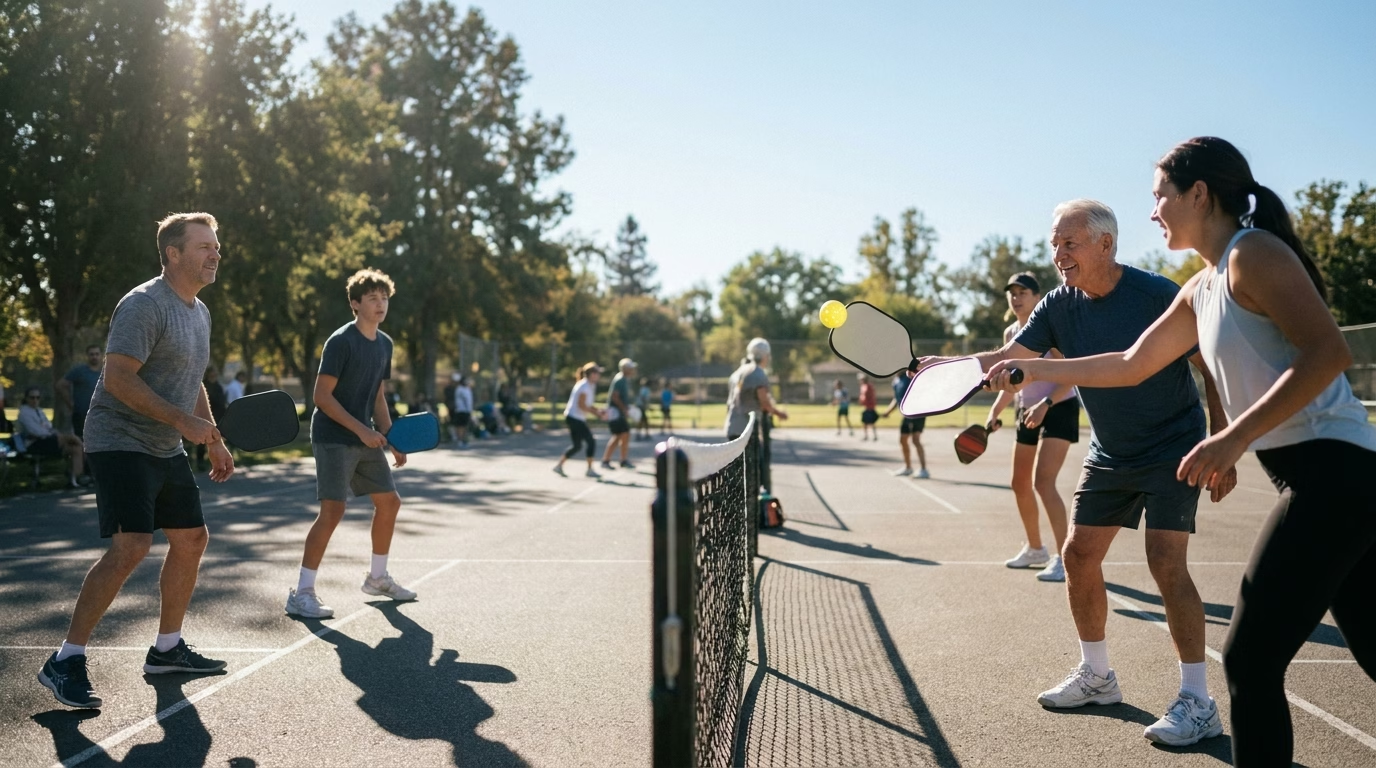
America’s fastest-growing sport doesn’t require athleticism, expensive memberships, or years of practice to enjoy. It just requires a paddle, a wiffle-like ball, and a court roughly the size of a large living room. Pickleball has gone from a backyard curiosity invented in 1965 to a mainstream phenomenon reshaping how millions of Americans think about recreational fitness — and the numbers prove it isn’t slowing down anytime soon.
The Growth Numbers Are Staggering
According to the Sports & Fitness Industry Association (SFIA), pickleball participation in the United States grew by 51.8% between 2022 and 2023, reaching approximately 13.6 million players. The Association of Pickleball Players (APP) and USA Pickleball have reported even broader estimates, with some surveys suggesting over 36 million Americans played at least once in 2023. Whether you accept the conservative or generous count, the trend line points in one direction.
The sport now claims more than 10,000 dedicated courts across the country, up from fewer than 1,000 a decade ago. Major metropolitan parks departments in cities like Austin, Denver, and Phoenix have converted underused tennis courts by the dozen, and standalone pickleball facilities have opened in suburban strip malls from New Jersey to California.
Who Is Actually Playing?
The demographics tell an interesting story. While the sport earned an early reputation as a retiree pastime, the player base has rapidly diversified. USA Pickleball’s most recent data shows that players aged 18–34 now represent the fastest-growing segment, accounting for roughly 28% of participants. Players 55 and older still make up a significant share — around 33% — but the median age of new players is trending younger every year.
This generational spread is part of what makes pickleball unique. On any given public court, you might see a 70-year-old competing fiercely against a 25-year-old, and the 70-year-old might win. The sport genuinely levels the playing field in ways that tennis and racquetball rarely do.
Why Pickleball Works for Almost Everyone
Three qualities explain pickleball’s broad appeal: a low barrier to entry, a built-in social structure, and minimal physical impact.
Low barrier. The court is 20 feet wide by 44 feet long — about a quarter of a tennis court’s square footage. Rallies are shorter, reaction distances are smaller, and the learning curve flattens dramatically. Most beginners can sustain a rally within their first hour of play, which creates immediate positive reinforcement that keeps them coming back.
Social by design. Doubles is the dominant format, meaning you’re almost always on a court with three other people. The game’s relatively slow pace — the plastic ball travels significantly slower than a tennis ball — allows for conversation, laughter, and friendly trash talk. Open play sessions, where strangers rotate in and out of games, function almost like a neighborhood block party. It’s difficult to leave without having made at least one new acquaintance.
Low physical impact. The underhand serve, the abbreviated court, and the slower ball speed mean that joints absorb far less shock than they do in tennis or running. A 2022 study published in the Journal of Aging and Physical Activity found that pickleball provided moderate-intensity cardiovascular exercise comparable to brisk walking, with significantly lower perceived exertion than tennis among older adults. For anyone managing knee issues, hip replacements, or general joint sensitivity, that distinction matters enormously.
Getting Equipped Without Spending a Fortune
You do not need to invest heavily to start playing well. A functional beginner setup costs well under $100.
Paddle: Entry-level paddles from reputable brands like Selkirk, Engage, or Paddletek run between $40 and $70. For first-time players, a mid-weight graphite or composite paddle in the $50 range is more than sufficient. Avoid the cheap $15 options sold in big-box toy sections — they’re usually made of wood and will actively slow your development.
Balls: Outdoor balls (slightly heavier, smaller holes) and indoor balls (lighter, larger holes) are technically different, though beginners shouldn’t worry much about that distinction yet. A pack of six outdoor balls typically costs $10–$14.
Shoes: This is where people cut corners dangerously. Running shoes are not designed for lateral movement and can contribute to ankle rolls and knee strain. Court shoes — designed for the side-to-side motion of racquet sports — make a real difference. Brands like K-Swiss, ASICS, and New Balance offer solid court shoes in the $40–$60 range. Combined with a paddle and balls, your total investment stays comfortably under $100.
How to Find Courts and Get Started
Free public courts are the easiest starting point. The USA Pickleball Places2Play map (available at usapickleball.org) lists thousands of free and paid courts nationwide by zip code. Most municipal parks with tennis courts have added pickleball lines, and many have designated hours for open play.
App-based open play has streamlined the social side of finding games. Apps like Pickleheads and Playtime Scheduler let you find open play sessions by location and time, view skill levels of other attendees, and RSVP to ensure there’s always a full court waiting. This removes the awkward experience of showing up solo and hoping someone is around.
Lessons are worth considering even for one or two sessions early on. USA Pickleball maintains a directory of certified instructors, and many recreational centers offer group clinics for $15–$25 per person. Learning proper grip, the “dink” (a soft shot that lands in the kitchen — the no-volley zone near the net), and basic court positioning from the start prevents bad habits that can take months to unlearn.
Rules and Scoring, Briefly
Pickleball is played to 11 points, win by 2, and points can only be scored by the serving team. Both players on a doubles team serve before the serve passes to the opponents (with one exception at the start of each game). The “two-bounce rule” requires that the ball bounce once on each side after the serve before volleys are permitted. The kitchen — the 7-foot non-volley zone on each side of the net — cannot be entered to hit a volley. These few rules are genuinely learnable in about 15 minutes, which is another reason the sport converts curious onlookers so efficiently.
Injuries to Avoid
Pickleball is low-impact, not no-impact. “Pickleball elbow” — lateral epicondylitis similar to tennis elbow — has become common enough that orthopedic clinics have coined the term. It typically results from overuse and poor paddle grip technique. Keeping your grip pressure light and warming up properly will significantly reduce your risk.
Achilles tendon strains are also reported frequently, particularly among older players returning to court sports after long breaks. The explosive lateral movements pickleball demands can catch deconditioned tendons off guard. A 10-minute dynamic warm-up including leg swings, calf raises, and lateral shuffles before play is a simple and effective prevention strategy.
The Pickleball-vs.-Tennis Debate
Tennis players have had mixed reactions to pickleball’s rise, and the friction is occasionally very real. Converted tennis courts mean fewer tennis courts, which has generated genuine conflict in parks departments from coast to coast. Tennis purists argue that pickleball’s lower skill ceiling makes it a lesser sport; pickleball advocates counter that accessibility is a feature, not a flaw.
The honest take is that the two sports serve different purposes. Tennis rewards years of dedicated practice with exponential returns on skill. Pickleball rewards participation almost immediately. Neither is superior — they occupy different lanes. Many former tennis players in their 50s and 60s who have migrated to pickleball report that they’re playing more often, socializing more, and feeling more connected to a community than they did in their final years on the tennis court. That’s not a knock on tennis; it’s evidence that pickleball fills a genuine gap.
Your First 30 Days: A Beginner Plan
Week 1 — Gear and orientation. Purchase a starter paddle and court shoes. Watch two or three beginner tutorial videos on YouTube (search “pickleball basics” from channels like Pickleball Kitchen or Third Shot Sports). Visit usapickleball.org to find the nearest public courts and identify one open play session nearby.
Week 2 — First court time. Attend one open play session. Focus entirely on consistency — keeping the ball in play — rather than power or placement. Don’t worry about winning. Introduce yourself to other players; most pickleball communities are genuinely welcoming to newcomers.
Week 3 — Add structure. Schedule a single group clinic or beginner lesson at a local recreation center. Ask specifically about the dink game and kitchen strategy, which separates beginners from intermediate players faster than any other single skill. Attend a second open play session during the week.
Week 4 — Build the habit. Aim for three sessions this week. Use the Pickleheads or Playtime Scheduler app to find a session on a day you haven’t played before, which exposes you to new players and different skill levels. At this point, you’ll have a foundational understanding of the rules, developing court awareness, and — most importantly — a reason to keep showing up.
Thirty days in, most beginners report the same thing: they’re hooked, and they can’t quite explain why. The combination of social connection, accessible competition, and the simple satisfaction of a perfectly executed dink down the line turns casual interest into genuine passion with remarkable speed. Given everything the data suggests about where this sport is heading, that experience is one that tens of millions more Americans are about to discover for themselves.
Sources and Further Reading
- SFIA 2023 Topline Participation Report: sfia.org
- USA Pickleball Places2Play court finder: places2play.org
- USA Pickleball certified instructor directory: usapickleball.org/grow-the-game/find-a-clinic-or-camp
- Pickleheads app (court and open play finder): pickleheads.com
- Playtime Scheduler app: playtimescheduler.com
- Selkirk Sport entry-level paddles (~$50–$70): selkirk.com
- Franklin Sports outdoor pickleballs, 6-pack (~$12): franklinsports.com
- K-Swiss Express Light pickleball shoes (~$55–$65): kswiss.com
- Journal of Aging and Physical Activity, “Pickleball as Moderate-Intensity Exercise” (2022): journals.humankinetics.com
