
All-Season vs. Winter Tires: Which Do You Really Need
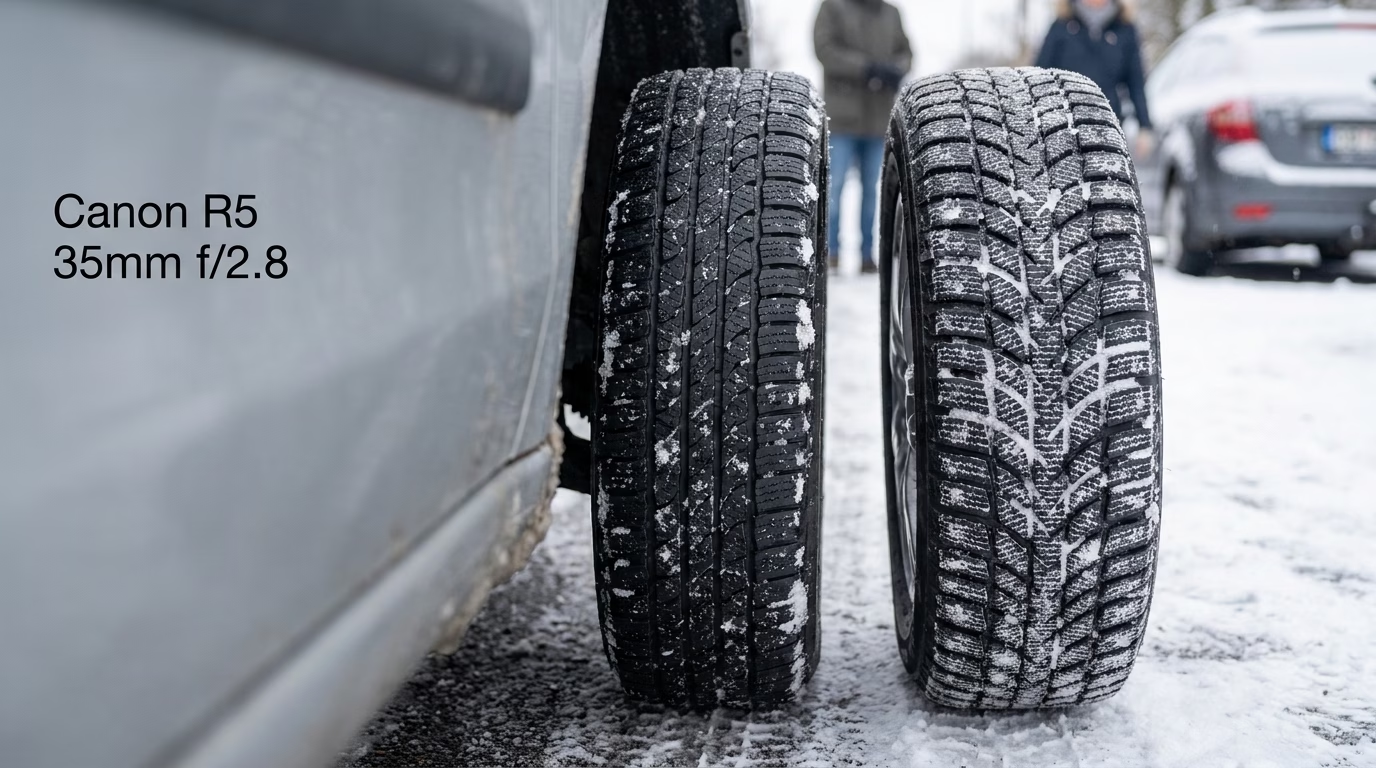
Winter arrives differently depending on where you live. For a driver in coastal Virginia, it might mean a handful of icy mornings per year. For someone in Minneapolis or Quebec City, it means months of snow-packed roads, black ice, and temperatures that hover well below freezing from November through March. That difference matters enormously when deciding whether to invest in a dedicated set of winter tires — a decision that carries real financial weight but also genuine safety implications for you and your family.
This guide cuts through the marketing noise to give you objective, data-grounded answers.
How Tire Compounds Differ Between All-Season and Winter Designs
The most fundamental difference between all-season and winter tires is not the tread pattern — it is the rubber compound itself.
All-season tires are engineered to perform adequately across a broad temperature range. Their rubber compound is designed to remain flexible and grippy from about 45°F (7°C) up through summer heat. Below that threshold, however, all-season rubber begins to stiffen. As the compound hardens, the tire loses its ability to conform to road surface micro-textures, reducing friction and, critically, grip.
Winter tires use a high-silica rubber compound that stays pliable at temperatures as low as -40°F (-40°C). This flexibility is not incidental — it is the entire engineering goal. A softer compound at low temperatures means the tire continuously molds itself to ice crystals and asphalt irregularities, maintaining the molecular-level contact needed for braking and cornering.
Beyond the compound, winter tires feature more aggressive tread designs with deeper grooves and a higher density of sipes — the tiny cuts across tread blocks that create additional biting edges. These sipes act like thousands of small squeegees, channeling water and slush away from the contact patch while biting into compacted snow. Many premium winter tires also incorporate specially engineered tread patterns that create a self-cleaning effect, expelling packed snow from grooves as the tire rotates.
The 7°C (45°F) threshold is the industry benchmark. Below this temperature, all-season tires are operating outside their designed performance range, regardless of whether there is visible snow or ice on the road.
Stopping Distance Tests and What the Data Shows
Laboratory marketing claims are one thing. Independent testing data is another.
The Tire Rack, one of North America’s largest independent tire testing organizations, has conducted extensive stopping distance comparisons under controlled winter conditions. In a frequently cited test on packed snow at speeds of 25 mph, vehicles equipped with winter tires stopped in approximately 25% shorter distances than identical vehicles on all-season tires. In some test configurations, that translated to a stopping distance difference of more than 20 feet — the length of a full-size pickup truck.
On ice, the gap widens further. The American Automobile Association (AAA) published testing showing that at 12 mph on ice, winter tires reduced stopping distances by up to 35% compared to all-season tires. At higher speeds, the compounding physics make the difference even more dramatic.
Transport Canada, the Canadian federal transportation authority, has released similar findings, noting that winter tires can reduce stopping distances on ice and snow by up to 25% compared to all-season tires. This data contributed to Quebec’s 2008 law mandating winter tires on passenger vehicles from December 1 through March 15 — the only jurisdiction in North America with such a requirement.
For parents of new drivers or households with children as passengers, these numbers carry particular weight. A 20-foot difference in stopping distance at typical neighborhood speeds is frequently the margin between a close call and a collision.
The Real Cost of Owning Two Sets of Tires
The upfront sticker shock of purchasing winter tires is real, but a five-year total cost-of-ownership analysis tells a more nuanced story.
Year One Investment:
– Set of four winter tires (mid-range, e.g., Michelin X-Ice Snow or Bridgestone Blizzak): $600–$900
– Four steel rims for seasonal mounting: $150–$300
– Initial mounting and balancing (if not DIY): $60–$100
– Year One Total: $810–$1,300
Annual Ongoing Costs (Years 2–5):
– Seasonal tire swap at a shop: $60–$100 per changeover, twice per year = $120–$200 annually
– DIY swap with a floor jack and torque wrench: $0 after initial tool investment
Where You Recover Costs:
Because you are alternating between two sets of tires, each set lasts roughly twice as long as a single set would. A quality all-season tire set that would normally last 50,000–60,000 miles now lasts 8–10 seasons when used only in warm months. Your winter set, used 4–5 months per year, similarly extends its lifespan. Over five years, you are effectively spreading one complete tire replacement cycle across two sets.
Additionally, insurance providers in some Canadian provinces offer premium discounts of 5–10% for winter tire use. In Quebec, provincial law ties insurance discounts directly to winter tire compliance. Even a modest 5% discount on a $1,500 annual premium saves $75 per year, or $375 over five years.
Five-Year Estimate (with shop swaps):
– Initial investment: ~$1,050 (midpoint)
– Seasonal swaps: ~$640
– Offset from extended tire life and insurance savings: -$500 to -$800
– Net five-year cost: approximately $890–$1,390
Spread over five years, dedicated winter tires cost roughly $180–$280 per year — less than the cost of a single rim replacement after an ice-related collision.
What Climate Threshold Makes Winter Tires Worth It
Apply this framework to your own city:
Tier 1 — Winter Tires Strongly Recommended:
Your region averages more than 20 days per year below 45°F (7°C), receives more than 20 inches of annual snowfall, or regularly experiences freezing rain and black ice. Cities in this tier include Minneapolis, Denver, Chicago, Buffalo, Montreal, Toronto, and most of Canada. If you live here and drive regularly during winter months, winter tires are not a luxury — they are a safety system.
Tier 2 — Winter Tires Worth Serious Consideration:
Your region sees 10–20 days below 45°F per year, occasional snowfall, or unpredictable freeze-thaw cycles. This includes cities like Philadelphia, Columbus, Kansas City, Portland (Oregon), and Seattle. Drivers in Tier 2 cities often underestimate their risk because major winter events are infrequent — but infrequency can mean local drivers are less experienced in winter conditions, and road treatment infrastructure may be less robust.
Tier 3 — All-Season Tires Are Likely Sufficient:
Fewer than 10 days per year below 45°F, minimal snowfall, and no regular ice events. Cities like Atlanta, Dallas, Houston, and Los Angeles generally fall here. However, if you regularly drive mountain routes or travel to Tier 1 regions, a set of winter tires is still worth considering.
A practical tool: check your city’s historical climate data through the National Weather Service (weather.gov) or Environment Canada to count average days below 45°F per year. That single metric is your most reliable guide.
How to Store Off-Season Tires Properly
Improper storage degrades tire compounds and shortens their lifespan significantly. Follow these steps to protect your investment.
Clean before storing. Wash tires with mild soap and water, removing brake dust, road grime, and any petroleum-based products. Allow them to dry completely before storage.
Store in a cool, dark, dry location. UV light, ozone (produced by electric motors), and heat are the primary enemies of rubber. Avoid garages with large appliances that generate ozone. A basement is often ideal.
Use tire bags. Large airtight plastic tire bags (available at most auto parts retailers for $10–$20 per set) reduce oxidation by limiting oxygen exposure. This is especially important for tires stored unmounted.
Stack or hang appropriately. Unmounted tires can be stacked horizontally (up to four high) or hung vertically on tire tack wall hooks. Mounted tires on rims should be stored vertically or hung, not stacked, to prevent flat-spotting under the weight of the rim.
Mark rotation position. Before removing tires each season, mark the position (front-left, front-right, etc.) with chalk or a paint pen. This allows you to continue a proper rotation pattern when reinstalling.
Tires stored correctly can remain in service for 6–10 seasons, further improving the long-term economics of a two-set approach.
Choosing the Right Winter Tire for Your Vehicle Type
Not all winter tires are created equal, and the right choice depends on your vehicle and driving conditions.
Passenger Cars in Moderate Winter Climates:
The Michelin X-Ice Snow and Bridgestone Blizzak WS90 are consistently top performers in independent testing for passenger sedans and coupes. Both prioritize ice braking and wet handling — relevant for mixed winter conditions.
SUVs and Crossovers:
Look for tires designated as winter SUV variants. The Continental VikingContact 7 and Pirelli Scorpion Winter are well-rated options that balance the higher vehicle weight and center-of-gravity characteristics of SUVs. All-wheel drive does not eliminate the need for winter tires — AWD helps you accelerate, but it does not improve braking or cornering on ice.
Trucks and Work Vehicles:
The Firestone Winterforce 2 UV and Toyo Observe GSi-6 HP are reliable choices for light trucks. If you carry heavy loads in winter, look for load-range ratings that match your vehicle’s GVWR.
Severe Alpine or Rural Conditions:
For drivers who regularly navigate mountain passes or rural unplowed roads, studded winter tires or tires with the Three-Peak Mountain Snowflake (3PMSF) certification offer additional traction. Note that studded tires are restricted or banned in some states, so verify local regulations.
The Rim Swap Advantage:
Purchasing a dedicated set of steel rims for your winter tires — rather than mounting them on your primary alloy wheels — dramatically simplifies seasonal changeovers. With a matched set of rims, you avoid annual mounting and balancing fees, and the swap becomes a simple at-home process: use a floor jack and jack stands, a breaker bar or impact wrench, and a torque wrench to re-torque lugs to your vehicle manufacturer’s specification (typically 80–120 ft-lbs for passenger vehicles, found in your owner’s manual).
The swap takes roughly 45–60 minutes for a first-timer and under 30 minutes once you’ve done it a season or two. This not only saves $60–$100 per changeover but puts you in control of your timing — you can swap on your schedule rather than waiting days for a shop appointment in peak November or April rush periods.
Winter tires are not the right investment for every driver. But for anyone in a Tier 1 or Tier 2 climate who drives with family members in the vehicle, commutes in early morning darkness when temperatures are coldest, or lives where a single ice event can close roads for days — the data makes a compelling case. The stopping distance margins are real, the five-year economics are defensible, and the peace of mind is difficult to quantify but easy to understand.
Sources and References
- Tire Rack Winter Tire Testing: tirerack.com
- AAA Winter Tire Testing Report: aaa.com/auto
- Transport Canada Winter Tire Safety: tc.gc.ca
- National Weather Service Climate Data: weather.gov
- Environment Canada Historical Climate Data: climate.weather.gc.ca
- Quebec Winter Tire Mandate and Insurance Discounts: saaq.gouv.qc.ca
- Michelin X-Ice Snow pricing reference: michelin.com and major retailers such as tirerack.com and discounttire.com
- Bridgestone Blizzak WS90 pricing reference: bridgestonetire.com
- Steel rim options for seasonal use: tirerack.com/wheels
