
How to Read Nutrition Labels: A No-Confusion Guide
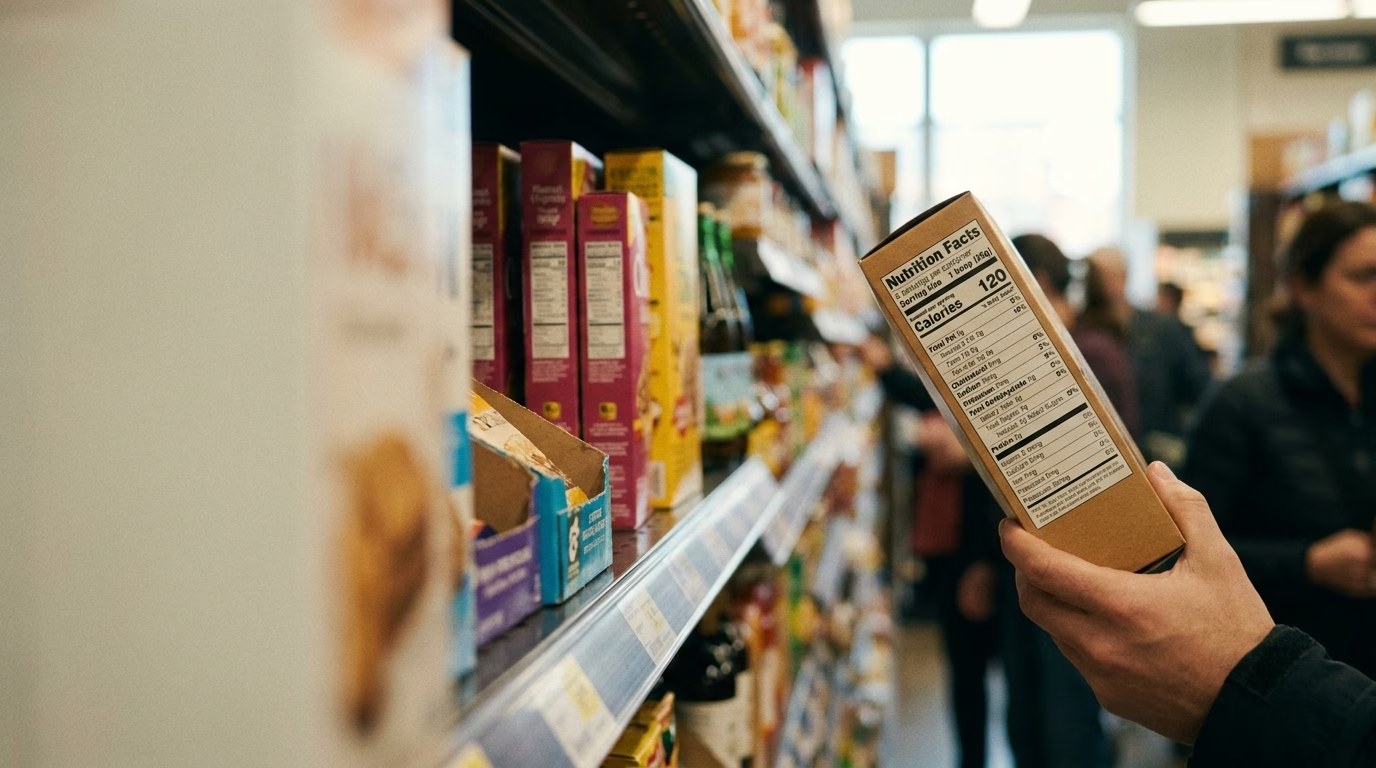
Why Your Grocery Cart Deserves Better: A Real Person’s Guide to Reading Food Labels
You’re standing in the cereal aisle, holding two boxes. One says “multigrain.” The other says “made with whole grains.” Both have a big golden sun on the front and a child gleefully eating breakfast. Neither one feels obviously wrong — but one of them has more sugar per serving than a glazed donut. Which one do you choose? If that moment feels familiar, this guide is for you.
Food labels exist to inform you, but they don’t always make that easy. Between small print, unfamiliar ingredients, and front-of-package claims that sound like headlines from a health magazine, it’s easy to feel manipulated rather than empowered. The good news? Once you know what to look for — and what to ignore — label reading takes about thirty seconds and can genuinely transform what ends up in your cart.
Why Nutrition Labels Exist and What Governs Them
Nutrition labels in the United States are not optional. They’re legally required on almost all packaged foods and are regulated by the U.S. Food and Drug Administration (FDA). The requirement dates back to the Nutrition Labeling and Education Act of 1990, which standardized the format you see today. The FDA updated the rules significantly in 2016, with most manufacturers required to comply by January 1, 2020. The update added things like a larger, bolder calorie count, a new line for added sugars, and updated daily value percentages based on more current nutritional science.
What this means for you: the Nutrition Facts panel on the back or side of a package follows a government-mandated format. The front of the package? That’s where companies can get creative. The front is largely marketing territory, and while some claims are regulated (we’ll get to that), others are surprisingly loosely defined.
The FDA also oversees the Generally Recognized as Safe (GRAS) designation for food additives. Ingredients on the label must be listed, but not all of them are scrutinized equally. Knowing this helps you understand why reading the label yourself — and not just trusting the packaging — is genuinely worth your time.
Breaking Down the Serving Size Problem
The single most manipulative element on a nutrition label is also the most overlooked: serving size. Everything on the label — every calorie count, every gram of sugar, every percentage of daily value — is based on that serving size. And serving sizes are not always what a real human being actually eats.
Consider a bag of chips. The label might say 140 calories per serving, with a serving size of about 15 chips. If you eat what most people would consider one sitting’s worth — closer to 30 chips — you’ve just doubled every number on that label. You’re at 280 calories, not 140.
The 2016 FDA update actually helped here: manufacturers are now required to base serving sizes on what people realistically eat, not aspirationally small portions. But gray areas still exist. A 20-ounce bottle of soda, for example, is now listed as a single serving — which is progress — but smaller packages with “about 2 servings” still trip people up constantly.
Your move: Before you read anything else on a label, look at the serving size and ask yourself, “Is this actually what I would eat?” If the package is small enough that you’d eat the whole thing in one sitting, multiply everything on the label accordingly.
Understanding Macronutrients on the Label
Once you’ve nailed down the serving size, the macronutrients — fat, carbohydrates, and protein — are the next stop. Here’s what each one actually tells you:
Total Fat is broken down into saturated fat, trans fat, and sometimes monounsaturated and polyunsaturated fats. Saturated fat should be relatively low (the American Heart Association recommends no more than 13 grams per day for most adults on a 2,000-calorie diet). Trans fat is the one to genuinely avoid — even 0.5 grams per serving can be listed as “0g” on the label due to rounding rules, so if you see “partially hydrogenated oil” in the ingredients list, there’s technically some trans fat in there regardless of what the panel says.
Total Carbohydrates includes fiber and sugars. Dietary fiber is your friend — aim for foods with at least 3 grams per serving when possible. Added sugars are now listed separately from total sugars, which is one of the most useful updates from 2016. Natural sugars (like those in milk or fruit) behave differently in your body than added sugars, so this distinction matters. The FDA recommends keeping added sugars under 50 grams per day on a 2,000-calorie diet.
Protein is listed in grams, but there’s no daily value percentage shown. The general recommendation is about 0.8 grams per kilogram of body weight per day for sedentary adults, though active individuals often need more.
How to Evaluate Micronutrients and Daily Values
The % Daily Value (%DV) column is your shortcut for micronutrients. The FDA’s rule of thumb is simple: 5% DV or less is considered low; 20% DV or more is considered high. You can use this across any nutrient.
For vitamins and minerals — like Vitamin D, calcium, iron, and potassium — higher is generally better. These are nutrients many Americans don’t get enough of. For sodium, saturated fat, and added sugars, lower percentages are better.
Sodium deserves special attention. The FDA recommends no more than 2,300 milligrams of sodium per day, but the average American consumes significantly more. A single can of soup can contain 800 to 900 milligrams — nearly 40% of your daily limit in one bowl. Scan the % DV for sodium on packaged soups, sauces, deli meats, and frozen meals, and look for options with 15% DV or lower per serving.
Decoding the Ingredients List and Additives
The ingredients list is listed in descending order by weight — meaning the first ingredient is the most plentiful, and the last is the least. A bread that lists “enriched flour” first and “whole wheat flour” fourth is primarily a white bread with some whole wheat mixed in, regardless of what the front says.
🚩 Red-Flag Ingredients to Scan for Quickly
- Partially hydrogenated oils — a source of trans fat
- High-fructose corn syrup — a highly processed sweetener linked to metabolic issues when consumed in excess
- Sodium nitrate/nitrite — preservatives common in processed meats, associated with increased cancer risk in large amounts
- Artificial colors (Red 40, Yellow 5, Yellow 6, Blue 1) — some studies suggest links to hyperactivity in children
- BHA and BHT — synthetic antioxidants used as preservatives; flagged by some health organizations as potentially problematic
- Carrageenan — a thickener derived from seaweed; may cause digestive inflammation in sensitive individuals
- Monosodium glutamate (MSG) — while generally recognized as safe, some people report sensitivity
A shorter ingredients list isn’t automatically better, but it’s often a useful heuristic. If you can pronounce most of the ingredients and recognize them as foods, that’s a reasonable green flag.
Marketing Claims vs. What the Label Actually Says
This is where food companies earn their marketing budgets. Here’s a quick translator for common front-of-package claims:
| The Claim | What It Actually Means |
|---|---|
| “Natural” | Almost nothing — FDA has no formal definition for this term on food labels |
| “Multigrain” | Contains multiple grains; they don’t have to be whole grains |
| “Made with whole grains” | Could be 5% whole grain and still qualify |
| “Low fat” | Fat has been reduced, often replaced with sugar or sodium |
| “Sugar free” | Less than 0.5g of sugar per serving, but may contain sugar alcohols |
| “Light” or “Lite” | Usually 1/3 fewer calories or 50% less fat than the original version |
| “Organic” | USDA certified; at least 95% organic ingredients — this one is meaningfully regulated |
| “Non-GMO” | No genetically modified organisms — regulated, but doesn’t necessarily mean healthier |
| “Gluten free” | Regulated by FDA; genuinely helpful for those with celiac disease, not inherently healthier for others |
Side-by-Side: Choosing Between Two Similar Products
Let’s say you’re choosing between two yogurts:
Yogurt A — Front says: “Strawberry Flavored, Low Fat, Good Source of Calcium”
– Serving size: 1 cup
– Calories: 180
– Total Fat: 2g | Saturated Fat: 1g
– Total Sugars: 28g | Added Sugars: 22g (44% DV)
– Protein: 6g
– First ingredients: Skim milk, strawberries, sugar, modified corn starch, artificial flavor
Yogurt B — Front says: “Plain Greek Yogurt”
– Serving size: 1 cup
– Calories: 130
– Total Fat: 0g
– Total Sugars: 7g | Added Sugars: 0g (0% DV)
– Protein: 22g
– First ingredients: Grade A skim milk, live active cultures
The verdict: Yogurt A sounds healthier from the front — it even says “low fat.” But the label reveals 22 grams of added sugar per serving, almost half your daily recommended limit. Yogurt B has more protein, no added sugar, and a two-ingredient list. If you want strawberry flavor, buy Yogurt B and add fresh strawberries. You’ll spend roughly the same amount and come out significantly ahead nutritionally.
Your Label-Reading Checklist (Screenshot This for Your Next Shopping Trip)
✅ Step 1 — Check serving size first. Would you actually eat this much, or more?
✅ Step 2 — Look at added sugars. Aim for 10% DV or less per serving.
✅ Step 3 — Check sodium. Look for 15% DV or less, especially in soups, sauces, and snacks.
✅ Step 4 — Scan saturated fat. Lower is better; avoid anything with trans fat.
✅ Step 5 — Assess fiber and protein. Higher fiber (3g+) and reasonable protein make food more filling.
✅ Step 6 — Read the first three ingredients. They make up the bulk of the product.
✅ Step 7 — Scan for red-flag ingredients. Partially hydrogenated oils, high-fructose corn syrup, artificial colors.
✅ Step 8 — Ignore front-of-package claims. Verify everything on the Nutrition Facts panel instead.
You’ve Got This
Reading food labels is a skill, not a talent — and like any skill, it gets faster and easier every time you practice it. You don’t need a nutrition degree or a calculator. You just need thirty seconds and a willingness to look past the golden sunshine and the happy children on the front of the box.
Start with one section of your grocery store. Pick up two similar products, run through the checklist above, and choose the one that holds up. That’s it. Over time, you’ll develop a sense of which brands and products genuinely deliver what they promise — and which ones are coasting on clever copywriting.
Your grocery cart is one of the most powerful health decisions you make. Now you have the tools to make it count.
Sources and Further Reading
- U.S. Food & Drug Administration — Changes to the Nutrition Facts Label: https://www.fda.gov/food/food-labeling-nutrition/changes-nutrition-facts-label
- FDA — How to Understand and Use the Nutrition Facts Label: https://www.fda.gov/food/nutrition-facts-label/how-understand-and-use-nutrition-facts-label
- American Heart Association — Saturated Fat Recommendations: https://www.heart.org/en/healthy-living/healthy-eating/eat-smart/fats/saturated-fats
- FDA — Added Sugars on the New Nutrition Facts Label: https://www.fda.gov/food/new-nutrition-facts-label/added-sugars-new-nutrition-facts-label
- USDA National Organic Program: https://www.ams.usda.gov/about-ams/programs-offices/national-organic-program
- FDA — Use of the Term Natural on Food Labeling: https://www.fda.gov/food/food-labeling-nutrition/use-term-natural-food-labeling
- Dietary Guidelines for Americans 2020–2025 (sodium and added sugar recommendations): https://www.dietaryguidelines.gov
