
Best Home Gym Equipment for Every Budget
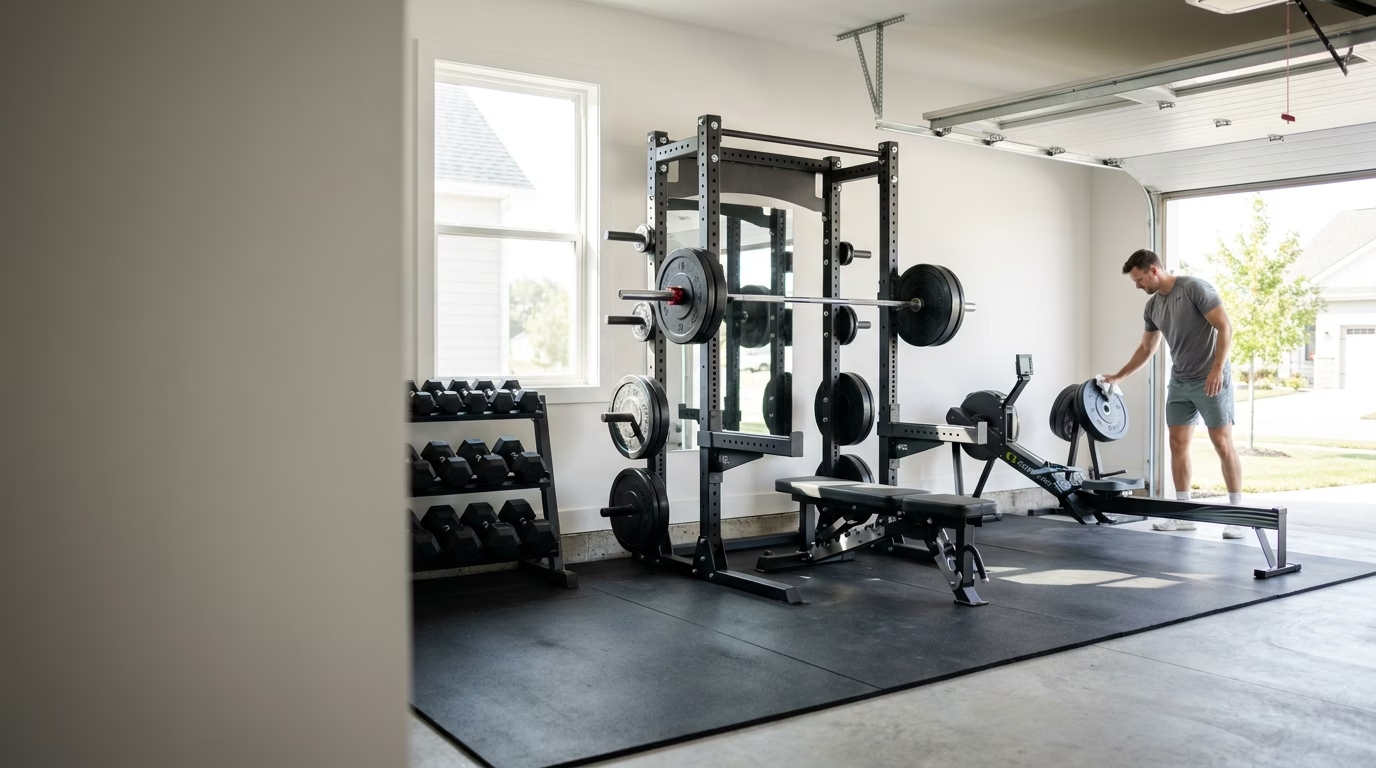
Building a home gym in 2026 is one of the smartest long-term fitness investments you can make. Commercial gym memberships have continued climbing in price, averaging $50–$80 per month in most U.S. cities, while the home fitness equipment market has matured significantly, offering better quality at more competitive prices than ever before. Whether you have a spare corner of a bedroom or a dedicated three-car garage, there is a functional, effective setup for your space and budget. This guide walks you through four realistic kit levels, the brands worth your money, what to avoid, and the practical details that make the difference between a gym you actually use and expensive equipment collecting dust.
Before You Buy Anything: Space and Floor Realities
The single biggest mistake first-time home gym builders make is buying equipment before measuring. A tight space with smart equipment beats a cluttered garage with redundant gear every time.
Minimum space benchmarks:
– 100–150 sq ft: Starter and basic intermediate setups. Think a large bedroom or single-car garage bay.
– 150–250 sq ft: Comfortable intermediate or entry-level advanced setup with a rack and bench.
– 300–400 sq ft: Advanced and premium setups with a cable machine, cardio equipment, and dedicated barbell work area.
Ceiling height matters equally. A standard power rack needs at least 8 feet of clearance; 9–10 feet is recommended if you plan to do overhead pressing with a barbell loaded on a rack. A 7-foot ceiling limits you to adjustable dumbbells, benches, and most cable machines but makes barbell overhead work difficult or impossible.
Floor protection is non-negotiable for anything beyond a yoga mat. Dropping a dumbbell or loading a barbell without proper flooring can damage subflooring, void homeowner’s insurance claims, and create noise that destroys family goodwill toward your gym. The industry standard is 3/4-inch thick rubber horse stall mats, sold at Tractor Supply Co. for approximately $50–$60 per 4×6 foot mat. For a 200 sq ft gym, budget $200–$300 in mats alone. Interlocking rubber tiles from brands like RubberFlooringInc or IncStores work well for lighter setups. Foam puzzle tiles are fine under a stationary bike but compress under heavy barbell work and are not recommended beneath a rack.
The $300 Starter Kit
Ideal for: Beginners, apartment dwellers, travelers, or anyone testing whether home training suits their lifestyle before committing further.
Space requirement: 50–100 sq ft — a cleared bedroom corner works.
The kit:
– Resistance bands set (~$25–$45): A full set covering light to heavy resistance handles most pulling, pressing, and lower-body exercises adequately. Recommended brands: Fit Simplify and Serious Steel both offer durable, layered latex bands with consistent resistance.
– Adjustable dumbbells (~$150–$200): The single most valuable piece in a starter kit. Selectorized adjustable dumbbells — where you dial or slide to change weight — save enormous space over a traditional rack. Recommended: Bowflex SelectTech 552s (adjusts 5–52.5 lbs, ~$199) remain a benchmark; the PowerBlock Sport 24 is a slightly more compact alternative at a similar price point.
– Exercise mat (~$20–$40): A 1/2-inch or 3/4-inch thick mat for floor work, stretching, and bodyweight movements. Gaiam and BalanceFrom both make reliable options in this range.
– Jump rope (~$15–$25): One of the most underestimated conditioning tools available. A basic speed rope from Crossrope or even an Amazon basics option handles the job at this level.
– Doorframe pull-up bar (~$30–$50): The Iron Gym Total Upper Body Workout Bar (~$35) fits most standard doorframes without drilling. For wider, more stable options, the Perfect Fitness Multi-Gym Pro runs about $50 and is worth the upgrade.
Total estimated cost: $240–$360
What to skip at this level: Avoid purchasing a bench at this stage unless you already have heavier dumbbells. A $50 folding bench paired with 25-lb dumbbells offers very limited value. Skip specialty resistance machines, foam rollers marketed as “recovery systems,” and any single-function cardio equipment. At this budget, versatility is everything.
The $1,000 Intermediate Kit
Ideal for: Someone training consistently for 3–6 months who needs progressive resistance, seated and incline work, and cardiovascular capacity beyond jump rope.
Space requirement: 100–150 sq ft minimum.
The kit (building on the starter):
– Adjustable weight bench (~$150–$250): A flat/incline/decline adjustable bench opens up a dramatically wider exercise library. Recommended: REP Fitness AB-3000 FID bench (~$199) offers commercial-level stability at a consumer price point. Flybird’s adjustable bench (~$159) is a popular budget-friendly alternative with solid reviews, though the wider footprint can feel unstable at higher incline angles under heavier loads.
– Kettlebell, 35–53 lbs (~$50–$80): A single heavy kettlebell adds ballistic training — swings, cleans, Turkish get-ups — that dumbbells handle awkwardly. Cast-iron kettlebells from Rogue Fitness, REP Fitness, or Kettlebell Kings (competition-style) are all excellent. Avoid coated big-box store kettlebells with poorly centered handles.
– Compact rower or stationary bike (~$500–$700): This is the biggest jump in cost at this level, but cardiovascular equipment transforms a weight room into a complete gym. Rower option: The Concept2 RowErg (~$900 new) is the gold standard and dominates commercial and home gyms globally. At the $1,000 total budget, buying a used Concept2 ($500–$650 on Facebook Marketplace or Craigslist) is the smartest move available. Bike option: The Sunny Health & Fitness SF-B1002C (~$300) is a reliable, stripped-down spin bike for those who prefer cycling. The Yosuda Indoor Cycling Bike Pro offers similar value at ~$280.
Total estimated cost (incremental): ~$700–$1,050 added to your starter kit
What to skip at this level: Skip “smart” mirrors, subscription-based connected fitness equipment, and any cardio machine that requires a monthly subscription to unlock basic features. At this budget, you want durable hardware, not recurring software costs.
The $3,000 Advanced Kit
Ideal for: Intermediate-to-advanced lifters focused on strength training, barbell movements, and progressive overload with real iron.
Space requirement: 150–250 sq ft with 8+ foot ceilings.
The kit (building on intermediate):
– Power rack (~$400–$700): The structural centerpiece of any serious home gym. Recommended: REP Fitness PR-4000 (~$650) and Rogue R-3 (~$545 base) are both excellent in this range. For tight spaces, a half rack like the Titan Fitness T-3 (~$399) takes up less floor space while still providing safety rails for solo heavy lifting. Avoid no-name imported racks below $250 — inconsistent welds and imprecise hole spacing create safety risks over time.
– Olympic barbell (~$200–$350): A quality barbell is a 20-year investment. Recommended: Rogue Ohio Bar (~$295), REP Sabre Bar (~$199), or the Texas Power Bar (~$330) for powerlifting-specific use. Buy once, buy right.
– Bumper plates (~$300–$500 for a starting set): Bumper plates — rubber-coated Olympic plates — allow you to drop lifts safely and protect your floor without additional mats under the lifting area. A starter set of 160–200 lbs (two 45s, two 35s, two 25s, and collars) is practical for most intermediate lifters. Recommended: Rogue Bumpers, REP Fitness Black Bumper Plates, or Titan Fitness Bumpers. If budget is tight, traditional iron plates (~$1.50–$2.00 per pound) cost less but require thicker flooring and should not be dropped.
– Fractional plates or microplates (~$30–$60): Small 1.25 lb or 2.5 lb plates allow micro-loading progressions — invaluable once you are pressing or deadlifting near your limits.
Total estimated cost (incremental): ~$900–$1,650 added to your intermediate kit
Bumper plates vs. iron plates: Bumper plates are thicker, meaning you can fit fewer on a bar — relevant if you’re lifting above 400 lbs. For most home gym users, bumpers are the better all-around choice given the floor protection and safety benefits. Iron plates are preferable if you’re squatting or deadlifting very heavy loads and need to fit more weight on the bar.
What to skip at this level: Lat pulldown attachments, functional trainers, and specialty bars are all things you may want eventually — but the foundational barbell work you can do with a rack, bar, and plates covers 90% of strength training needs. Skip them here and revisit at the next level.
The $7,500 Premium Kit
Ideal for: Dedicated strength and conditioning athletes, serious lifters, or households where multiple people train with different goals.
Space requirement: 300–400 sq ft with 9–10 foot ceilings preferred.
The kit (building on advanced):
– Full power rack with full accessory package (~$800–$1,500): Step up to a four-post full rack with lat pulldown attachment, cable pulley system, dip bars, band pegs, and multi-grip pull-up bar. Recommended: Rogue Monster Lite RM-4 (~$1,200+), Titan Fitness X-3 Flat Foot ($750 base with accessories bringing it to $1,200+), or REP PR-5000 (~$900 with attachments).
– Full dumbbell set or expanded adjustable dumbbells (~$500–$1,500): Either a fixed dumbbell rack with pairs from 10–75 lbs (~$1,200–$1,500) or upgraded adjustable dumbbells like the Bowflex SelectTech 1090 (5–90 lbs, ~$599/pair) for space efficiency.
– Expanded plate set (~$400–$700): Bring total plate weight to 400–600 lbs, adding heavier pairs and additional 45 lb plates. Mixing iron and bumper plates is practical at this level.
– Cable machine or functional trainer (~$1,000–$2,000): A standalone cable machine dramatically expands upper body, core, and accessory exercise options. Recommended: REP Fitness FT-100 Functional Trainer (~$1,299), Force USA G3 or G6 all-in-one ($1,499–$1,999), or the Body-Solid GCBT380 dual stack tower (~$1,800). These machines cover cable rows, tricep pushdowns, face pulls, cable flyes, and lat pulldown variations that no barbell or dumbbell replaces cleanly.
– Premium cardio piece (~$1,200–$2,500): At this budget, upgrade to a Concept2 RowErg ($900), AssaultBike Classic (~$699) or FanBike Pro (~$999), or NordicTrack Commercial 1750 treadmill (~$1,799). The choice depends entirely on your preferred modality — cycling, rowing, or running.
Total estimated cost: ~$6,500–$9,500 depending on selections
What to skip even at this level: Whole-body vibration platforms, most “smart” connected equipment with subscriptions, and overcrowded cardio options. More is not always better — a focused premium setup beats a cluttered equipment showroom.
The Used Market: Your Most Powerful Tool
Regardless of which budget level applies to you, the used market can cut costs by 30–60% on almost everything. Key platforms to check:
- Facebook Marketplace and Craigslist: The best sources for local, no-shipping deals on racks, barbells, plates, and benches.
- OfferUp: Growing inventory of gym equipment, especially post-New Year as resolution equipment gets resold.
- Rogue Boneyard (rogefitness.com/boneyard): Cosmetically imperfect but fully functional Rogue equipment at 20–40% discounts — one of the best deals in the industry.
- DICK’S Sporting Goods Used Equipment: Occasionally runs certified used trade-in programs.
What to buy used: Plates, barbells, benches, racks, kettlebells, rowing machines (especially Concept2s), and spin bikes hold up extremely well over time. A 20-year-old Concept2 rower with regular maintenance is essentially identical to a new one.
What to buy new: Resistance bands (old bands crack without warning), adjustable dumbbells with selectorized mechanisms (worn selector pins are a safety issue), anything with cables, pulleys, or cables — worn cables are a liability. Cardio electronics are also safer to buy new or certified refurbished.
Final Recommendations
A home gym pays for itself within 18–36 months compared to a mid-range commercial membership in most U.S. markets. Start with the kit that honestly matches your current fitness level and available space, not your aspirational one. A $300 setup used five days a week beats a $3,000 setup used twice a month every time. Buy quality where it matters most — barbell, rack, and flooring — and be patient with the rest. The used market rewards those who wait.
Sources and Pricing References
- Bowflex SelectTech 552 Adjustable Dumbbells: bowflex.com (~$199 as of 2025)
- Concept2 RowErg Rowing Machine: concept2.com (~$900 new)
- REP Fitness Power Racks, Benches, Plates, and Functional Trainers: repfitness.com
- Rogue Fitness Barbells, Racks, and Boneyard Deals: roguefitness.com
- Titan Fitness X-3 and T-3 Racks: titanfitness.com
- Rubber Horse Stall Mats: tractorsupply.com (~$50–$60 per 4×6 mat)
- Treadmill and Cardio Equipment Pricing: nordictrack.com
- AssaultBike Pricing: assaultfitness.com
- Gym Membership Cost Averages (2024–2025): statista.com and valuepenguin.com
- Used Equipment Marketplace: facebook.com/marketplace, offerup.com
Prices reflect approximate market values as of late 2025 and early 2026 and are subject to change. Always verify current pricing directly with retailers before purchasing.
