
All-Season vs. Winter Tires: Which Do You Really Need
Introduction
For drivers in regions where temperatures regularly dip below freezing, few decisions carry more practical weight than whether to invest in a dedicated set of winter tires. All-season tires remain the default choice for most North American drivers—convenient, versatile, and requiring no seasonal swap. But convenience and safety are not always the same thing. This guide cuts through the marketing noise with data, cost analysis, and a practical framework to help you decide whether winter tires make sense for your specific situation.
How Tire Compounds Differ Between All-Season and Winter Designs
The most fundamental difference between all-season and winter tires is invisible to the naked eye: the rubber compound itself.
All-season tires are engineered with a compound that performs across a wide temperature range—roughly 40°F (4°C) and above. This versatility is achieved through a harder rubber formulation that resists wear in warm months. The trade-off is predictable: as temperatures fall below that threshold, the compound begins to stiffen. A harder tire creates less contact with the road surface, which directly reduces traction, cornering grip, and braking efficiency.
Winter tires use a silica-enriched, softer rubber compound specifically designed to remain pliable in cold temperatures, including well below 0°F (-18°C). This elasticity allows the tire to conform to road surface irregularities, ice texture, and compacted snow rather than riding on top of them. Think of the difference between pressing a cold stick of butter against a surface versus a room-temperature one—only one of them actually grips.
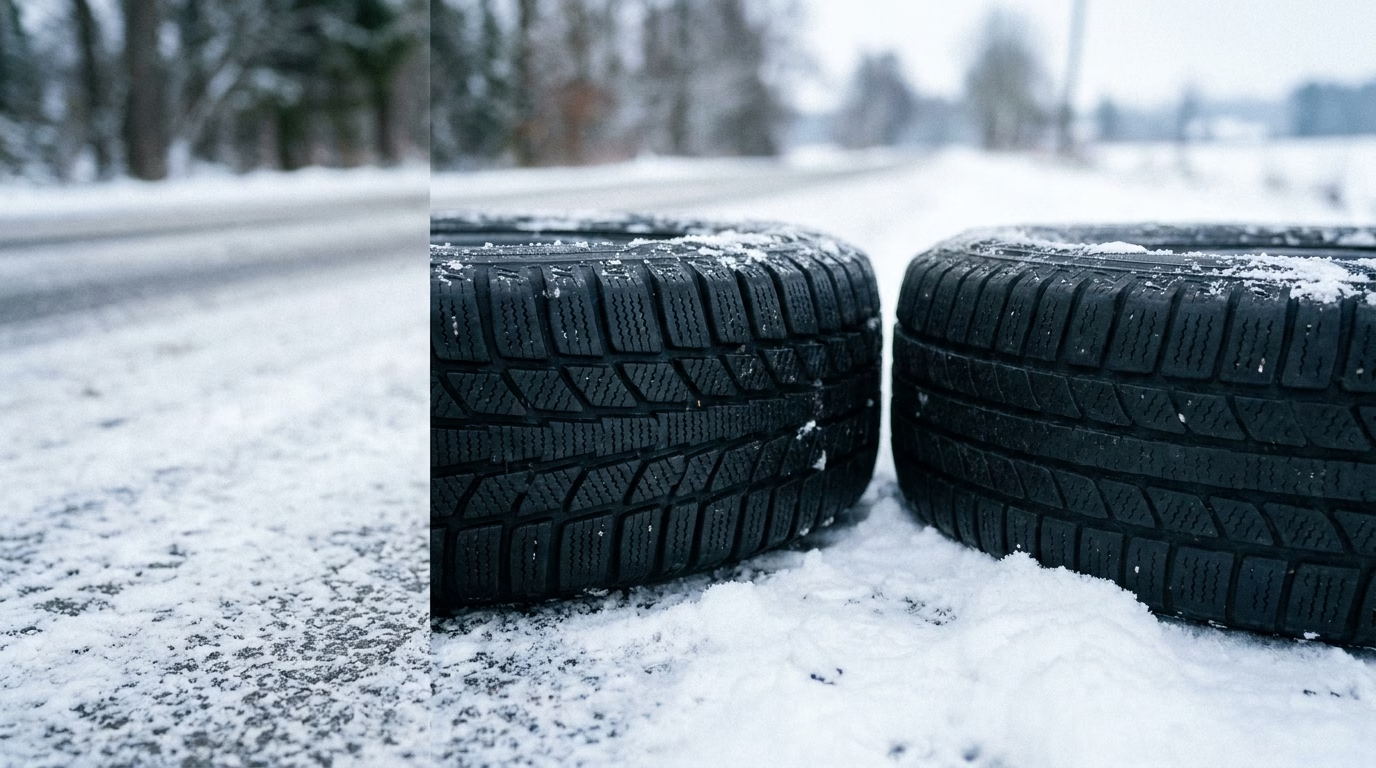
Beyond the compound, winter tires feature a fundamentally different tread architecture. The tread blocks are deeper, typically 10/32″ to 11/32″ compared to 8/32″ to 9/32″ on all-seasons, allowing the tire to channel and evacuate slush and snow more aggressively. More distinctively, winter tires are covered in thousands of tiny slits called sipes. These sipes create hundreds of additional biting edges that grip ice and hardpack at a microscopic level, functioning almost like a brush that bends and grabs the surface rather than sliding over it.
The result is a tire that was designed from the molecular level up for a single purpose: controlled performance in cold, wet, icy, and snowy conditions.
Stopping Distance Tests and What the Data Shows
Abstract descriptions of rubber compounds matter less to most drivers than a concrete answer to one question: how much shorter does my car actually stop?
The data here is striking. Testing by the Tire and Rubber Association of Canada (TRAC) and independent studies from organizations like Consumer Reports and TÜV SÜD consistently show that at 31°F (0°C) on snow or ice, vehicles equipped with winter tires stop in dramatically shorter distances than those on all-season tires.
One widely cited TRAC test found that a vehicle traveling at 50 km/h (31 mph) on winter tires stopped in approximately 35 meters on snow. The same vehicle on all-season tires required 58 meters—a difference of 23 meters, or roughly 66% more stopping distance. At highway speeds, that gap widens considerably.
Consumer Reports testing on ice at 12 mph found that winter tires outperformed all-season tires by up to 30 feet in stopping distance. In a real-world scenario, 30 feet is the difference between stopping before the intersection and entering it.
Perhaps most counterintuitively, modern winter tires also outperform all-season tires in cold rain. Because the rubber stays pliable below 45°F (7°C), it maintains hydroplaning resistance more effectively than a stiffened all-season compound, which tends to plane over thin water films rather than displace them.
SUV and truck drivers should pay particular attention to this data. Four-wheel drive and all-wheel drive systems improve acceleration traction but do nothing to shorten stopping distances. A large SUV on all-season tires traveling at 35 mph on ice will slide just as far—and often farther due to vehicle weight—as a sedan, regardless of drivetrain configuration.
The Real Cost of Owning Two Sets of Tires
The upfront cost of winter tires causes many drivers to hesitate. That hesitation makes sense until you examine the math over time.
Total Cost-of-Ownership Breakdown Over Five Years
Assume a mid-size sedan needing 205/55R16 tires:
- Winter tire set (4 tires): $600–$900 for reputable brands such as Michelin X-Ice, Bridgestone Blizzak, or Continental WinterContact
- Steel rim set (4 rims) for seasonal swapping: $200–$400 (steel rims are significantly cheaper than alloy and resist winter road salt better)
- Tire mounting and balancing (one-time): $80–$120
- Seasonal tire changeover (twice per year, 5 years = 10 swaps): $25–$40 per swap at most shops, or free if you do it yourself with a torque wrench
Total five-year winter tire investment: approximately $1,100–$1,620
Now consider the offset: because you are rotating usage between two sets, each set lasts proportionally longer. If you drive 15,000 miles per year in a climate where winter tires are used 4–5 months annually, your all-season tires will last approximately 40% longer than they would running year-round. At a replacement cost of $600–$800 per all-season set with a typical lifespan of 50,000–60,000 miles, you save one full replacement cycle over five years—roughly $600–$800.
Net added cost over five years: approximately $300–$820, or $60–$164 per year.
Set against the cost of a single fender-bender—average repair cost in the U.S. is $3,000–$4,000 according to data from the Insurance Information Institute—the math resolves quickly. Several Canadian insurance providers also offer discounts of 2–5% for drivers who can prove winter tire use, partially offsetting the cost further.
What Climate Threshold Makes Winter Tires Worth It
Not every cold-climate driver needs winter tires. The decision should be driven by data about your specific location.
The Climate-Zone Decision Framework
Apply these questions to your city:
- Does your area average more than 25 days per year below 45°F (7°C)? If yes, your all-season tires are already operating in a degraded state for a significant portion of the year, even without visible snow.
- Does your city receive more than 5 inches of cumulative snowfall per year? Even light, periodic snowfall events create disproportionate accident risk because roads are not always treated before drivers are already on them.
-
Do temperatures regularly fluctuate around the freezing mark? Freeze-thaw cycles create black ice, which is more dangerous than several inches of fresh snow. Cities like Nashville, Tennessee; Portland, Oregon; and Charlotte, North Carolina, experience this pattern more frequently than cities in deep winter zones.
-
Do you routinely drive in early morning or late evening? Temperatures are at their lowest then, meaning roads freeze before salting crews respond.
General guidance by zone:
– Zone 1 – Deep winter (Minneapolis, Calgary, Chicago, Buffalo): Winter tires are strongly recommended. The case is clear.
– Zone 2 – Moderate winter (Denver, Toronto, Boston, Seattle): Winter tires are recommended, particularly for hilly terrain or highway commuters.
– Zone 3 – Occasional winter (Nashville, Portland, Atlanta): Situationally beneficial. Drivers who are on the road frequently or who commute before roads are treated will benefit.
– Zone 4 – Mild winter (Houston, Phoenix, Los Angeles): All-season tires are generally sufficient.
How to Store Off-Season Tires Properly
Improper storage degrades tire performance and shortens lifespan. Done correctly, a good set of winter tires stored seasonally can last 6–8 seasons.
Rim Swap Tutorial for Easier Seasonal Changeovers
Mounting your winter tires on their own dedicated steel rims dramatically simplifies the seasonal process and eliminates repeated mounting/dismounting wear on your tire beads.
Steps for a DIY seasonal rim swap:
1. Loosen lug nuts slightly before lifting the vehicle (break resistance while the wheel is on the ground).
2. Use a floor jack at the manufacturer’s specified jack point and support with jack stands. Never rely on a jack alone.
3. Remove lug nuts fully and pull the wheel.
4. Mount the pre-assembled winter wheel (tire already on rim) and hand-tighten lug nuts in a star pattern.
5. Lower the vehicle and torque lug nuts to spec (typically 80–100 ft-lbs for most passenger vehicles—check your owner’s manual).
6. A torque wrench costs $30–$60 and pays for itself immediately. Over-tightened or improperly torqued lug nuts cause warped rotors and stripped studs.
Storage Best Practices:
– Clean tires thoroughly before storage to remove road salt and debris.
– Store in a cool, dark, dry location away from ozone sources (electric motors, furnaces).
– Keep tires away from direct sunlight and petroleum-based products, which accelerate rubber oxidation.
– Store unmounted tires stacked horizontally, not standing upright, to prevent sidewall deformation.
– Mounted tires on rims can be stored upright or hung on a wall-mounted rack.
– Consider tire storage bags ($30–$60 for a set of four) to reduce ozone and UV exposure.
Choosing the Right Winter Tire for Your Vehicle Type
Not all winter tires are the same, and matching the tire to the vehicle and use case matters.
Passenger Sedans and Hatchbacks
For urban and suburban commuters, touring winter tires like the Michelin X-Ice Snow, Bridgestone Blizzak WS90, or Continental WinterContact SI offer the best balance of ice traction, road noise, and tread life. These tires are designed for paved roads that receive regular treatment and prioritize ride comfort alongside safety performance.
SUVs and Crossovers
Look for winter tires rated for SUV/CUV loads. The Michelin X-Ice Snow SUV, Pirelli Scorpion Winter, and Goodyear WinterCommand Ultra are purpose-built for the heavier weight and higher center of gravity of these vehicles. Fitting a car-rated winter tire on a heavy SUV can result in uneven wear and compromised handling under load.
Trucks and Work Vehicles
For light-duty pickup trucks used in genuinely harsh conditions—unpaved roads, worksites, deep snow—consider a studded winter tire or a tire with an aggressive lug pattern. The Cooper Discoverer True North and Firestone Winterforce 2 UV are frequently recommended in this category.
Performance Vehicles
Drivers of rear-wheel-drive performance vehicles face the steepest winter challenges. The Michelin Pilot Alpin series and Continental WinterContact TS 870 P are designed to retain handling responsiveness while providing winter-rated traction—critical for vehicles where rear-end instability can quickly become dangerous.
When selecting tires, always verify the 3-Peak Mountain Snowflake (3PMSF) symbol. This certification indicates the tire has met minimum snow traction performance standards in controlled testing and is a meaningful indicator of genuine winter capability. The older M+S designation, by contrast, is a self-reported manufacturer claim with no independent verification.
Final Takeaway
Winter tires are not a luxury for drivers in cold climates—they are safety equipment whose performance advantage over all-season tires is well-documented and measurable in real stopping distances. The cost over five years is lower than many drivers assume, particularly when measured against the extended life of all-season tires and the potential savings on insurance and collision repair. Using the climate-zone framework above, most drivers in Zones 1 and 2 will find that the calculation is straightforward. Drivers in Zone 3 should weigh their personal commuting patterns and risk tolerance carefully. Whatever your decision, making it with accurate data rather than habit is always the right starting point.
Sources and References
- Tire and Rubber Association of Canada (TRAC) – Stopping Distance Data: https://www.tiresafetycanada.com
- Consumer Reports – Winter vs. All-Season Tire Testing: https://www.consumerreports.org/tires/
- TÜV SÜD Winter Tire Testing Reports: https://www.tuvsud.com
- Insurance Information Institute – Average Auto Repair Costs: https://www.iii.org
- Michelin X-Ice Snow pricing reference: https://www.tirerack.com
- Bridgestone Blizzak WS90 pricing reference: https://www.tirerack.com
- Steel rim pricing reference: https://www.discounttire.com
- 3-Peak Mountain Snowflake certification standard: https://www.rubberассоciation.ca
- Tire storage bag options: https://www.amazon.com (search: “tire storage bags set of 4”)
