
How to Lower Your Electricity Bill This Summer
Summer electricity bills have a way of arriving like unwelcome guests — right when you’re already sweating through the hottest weeks of the year. The average American household spends roughly $400–$500 more on electricity during summer months, driven largely by air conditioning loads that can account for 50% or more of total usage. The good news is that a combination of smart habits, low-cost upgrades, and strategic timing can meaningfully shrink that number without sacrificing comfort. This guide walks through every major lever you can pull — from thermostat settings to utility rebates — along with a 30-day action plan tailored for both renters and homeowners.
Thermostat Strategy: The 78°F Rule
The single most impactful change most households can make costs nothing at all: adjusting thermostat setpoints intentionally. The U.S. Department of Energy recommends setting your thermostat to 78°F when you’re home and 85°F when you’re away during summer. For every degree you raise the setpoint above 72°F, you save approximately 3% on cooling costs.
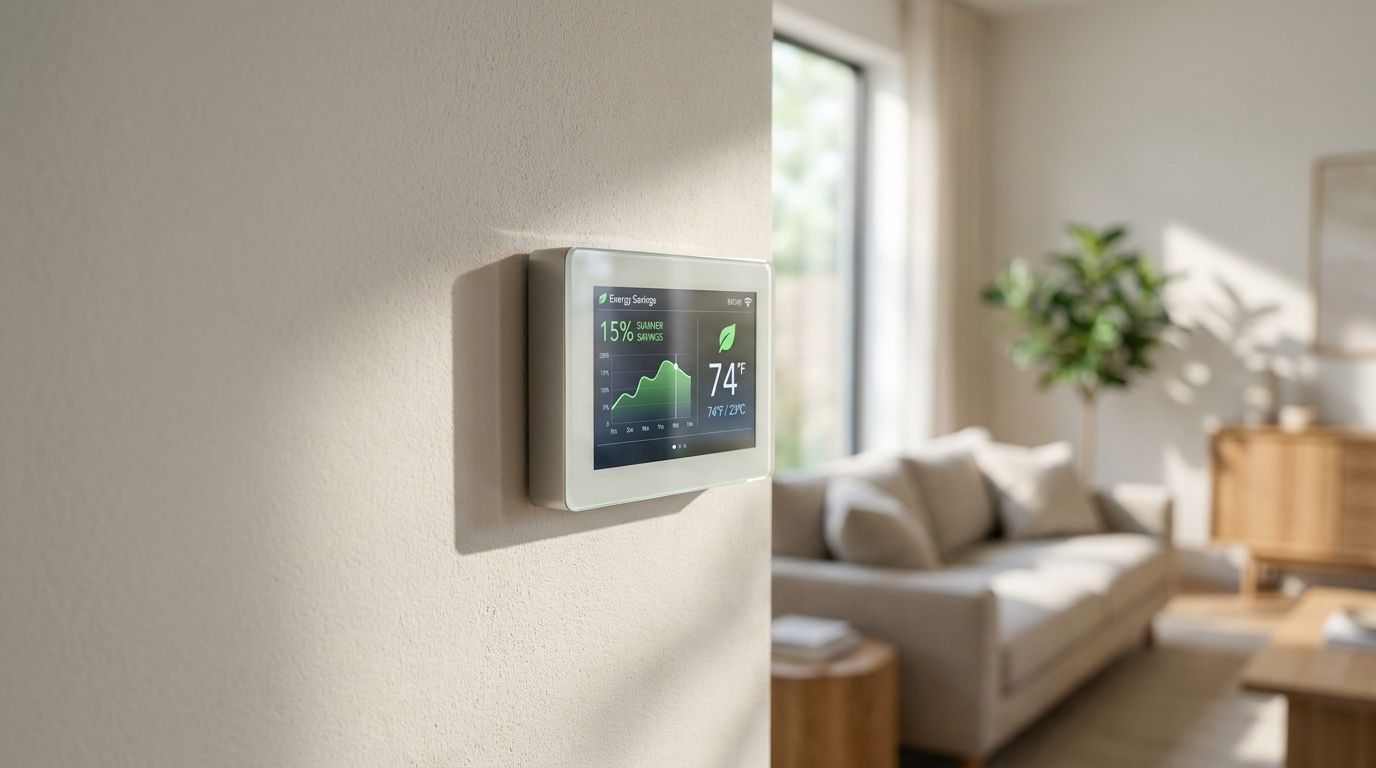
If 78°F sounds uncomfortably warm, know that pairing it with ceiling fans (covered next) makes it feel roughly 4°F cooler. A programmable or smart thermostat makes this effortless by automating the schedule. The Nest Thermostat (around $130) and Ecobee SmartThermostat ($250) both learn your patterns and optimize run times. Studies show smart thermostat users save an average of 10–12% on cooling costs annually. Set up “away” schedules to kick in 30 minutes before you leave and return to 78°F about 30 minutes before you arrive home — your system works most efficiently when it maintains a range rather than recovering from extreme heat.
Ceiling Fan Direction: A Free Fix You Might Be Ignoring
Ceiling fans don’t cool air — they cool people by creating a wind-chill effect. In summer, your fan blades should spin counterclockwise (when viewed from below), pushing air straight down and creating that cooling breeze. Most fans have a small direction switch on the motor housing.
Running ceiling fans correctly allows you to raise the thermostat by 4°F with no reduction in perceived comfort, translating to real dollar savings. The important caveat: turn fans off when you leave a room. A fan running in an empty room wastes energy because it cools people, not spaces.
Window Film and Blackout Curtains: Blocking Heat Before It Enters
Up to 30% of unwanted heat enters a home through windows, according to the Department of Energy. Blocking it at the source is far more efficient than running your AC harder to compensate.
Window film is a thin, adhesive layer applied directly to glass that reflects solar heat. Quality reflective or low-emissivity films reduce solar heat gain by 40–70% and cost roughly $0.50–$2.00 per square foot for DIY products. Professional installation runs $5–$15 per square foot but often comes with warranties. South- and west-facing windows benefit most, since they receive peak afternoon sun.
Blackout curtains are a renter-friendly alternative that requires no tools or landlord permission. A good set of blackout curtains (typically $25–$60 per panel) can reduce heat gain through a window by around 24–33%. Layering both solutions — film plus curtains — delivers the strongest result. Close curtains on south- and west-facing windows between 10 a.m. and 4 p.m. to keep rooms noticeably cooler.
Sealing Duct Leaks: The Hidden Energy Thief
In homes with forced-air HVAC systems, duct leakage is one of the most underestimated sources of wasted energy. The EPA estimates that the typical home loses 20–30% of conditioned air through leaky, poorly connected, or uninsulated ducts — air you’ve already paid to cool escaping into attics, crawl spaces, and wall cavities.
Accessible duct joints in attics and basements can be sealed with mastic sealant (around $10–$15 per quart) or metal-backed foil tape (not standard duct tape, which fails over time). This is a DIY-friendly job for accessible sections. For a full duct audit and professional sealing, expect to pay $300–$1,000, though utility rebates frequently cover a significant portion of that cost. Homes with severe leakage often see energy bills drop by 15–20% after professional sealing.
Smart Power Strips: Eliminating Phantom Loads
Electronics and appliances in standby mode — TVs, gaming consoles, cable boxes, chargers — collectively draw what’s called phantom load or standby power. The Lawrence Berkeley National Laboratory estimates phantom loads account for about 10% of residential electricity use.
Smart power strips solve this automatically. They detect when a “master” device (like your TV) shuts off and cut power to all connected “slave” outlets (soundbar, gaming console, streaming stick), eliminating standby draw. Prices range from $25–$50 for a quality smart strip. In summer, when your overall usage is already elevated, eliminating phantom loads provides a proportionally larger benefit.
Switching to LED Lighting: Cool, Cheap, and Immediate
If you still have any incandescent bulbs in your home, summer is the perfect time to complete your LED transition. Incandescent bulbs convert only about 10% of their energy into light — the remaining 90% becomes heat. In summer, that heat forces your AC to work harder, creating a compounding cost.
LED bulbs use 75% less energy than incandescents and produce far less heat. While LED bulbs once carried a price premium, costs have dropped dramatically. Standard LED bulbs now cost $1–$4 each at most hardware stores and last 15,000–25,000 hours. A household replacing 20 incandescent bulbs with LEDs can save $80–$100 per year on electricity — plus reduce the cooling load on their AC during summer.
Induction vs. Traditional Electric Stove: Cook Smarter in the Heat
Cooking is a significant source of indoor heat gain during summer, and the type of stove you use matters more than most people realize. Traditional electric coil ranges waste roughly 40–50% of their heat energy to the surrounding air before it ever reaches the pot.
Induction cooktops are dramatically more efficient — they transfer approximately 84–90% of energy directly to the cookware using electromagnetic fields, generating almost no ambient heat. This means a cooler kitchen and less work for your air conditioner. Portable induction burners are an excellent option for renters, starting at around $40–$80 for a single burner. Full induction ranges run $1,000–$3,000, but many utilities offer rebates when you switch from electric resistance to induction. Even if you can’t switch permanently, using a portable induction burner for high-heat summer cooking — boiling pasta, searing — makes a tangible difference in kitchen comfort and energy use.
EnergyStar Appliance Picks
If you’re replacing appliances during summer, prioritizing ENERGY STAR certified models ensures you’re choosing the most efficient options available. Some standout categories for summer savings:
- Room air conditioners: ENERGY STAR certified units are about 10% more efficient than standard models. Look for a high SEER (Seasonal Energy Efficiency Ratio) rating — 16 SEER or above is considered high efficiency.
- Dehumidifiers: In humid climates, running a dehumidifier allows you to raise the AC setpoint without sacrificing comfort. ENERGY STAR dehumidifiers use about 15% less energy than standard models.
- Refrigerators: Your fridge runs 24/7. ENERGY STAR certified refrigerators use about 9% less energy than the federal minimum standard, saving roughly $50/year.
- Ceiling fans: Yes, ceiling fans have ENERGY STAR ratings too. Certified fans move air 20% more efficiently and use 60% less energy than conventional fan/light units.
The ENERGY STAR website (energystar.gov) maintains updated product lists and often links to local utility rebate programs, making it easy to stack manufacturer savings with utility incentives.
Time-of-Use Pricing Optimization
Many utilities now offer time-of-use (TOU) pricing, where electricity costs more during peak demand hours (typically 4–9 p.m. in summer) and less during off-peak hours (nights and weekends). If your utility offers TOU rates, shifting energy-intensive tasks can generate significant savings without reducing your comfort at all.
Practical shifts include: running the dishwasher after 9 p.m., scheduling washing machine and dryer cycles for early morning or late night, charging electric vehicles overnight, and pre-cooling your home to 74°F before peak hours begin — then letting the thermostat drift up to 78°F during the expensive window. Some utilities also offer demand response programs, where you allow the utility to make brief, minor adjustments to your thermostat during grid stress events in exchange for bill credits.
Check your utility’s website or call their customer service line to ask about TOU plans and enrollment bonuses, which sometimes include a free smart thermostat.
Free Utility Audits and Rebates
Most people don’t realize their utility company will send a trained professional to their home — for free — to identify energy waste. Home energy audits (also called energy assessments) typically include blower door tests to find air leaks, infrared scans to locate insulation gaps, HVAC efficiency checks, and appliance assessments. The auditor provides a prioritized list of improvements along with any rebates or incentive programs available.
Beyond audits, utility rebates cover a wide range of upgrades: smart thermostats ($50–$100 rebates are common), ENERGY STAR appliances, insulation, duct sealing, and LED lighting. Federal tax credits under the Inflation Reduction Act also provide up to 30% back on qualifying home efficiency improvements, including insulation, air sealing, and heat pumps. Start at your utility’s website, then check the DSIRE database (dsireusa.org) for state and local incentives specific to your zip code.
30-Day Quick-Win Checklist for Renters and Owners
Use this checklist to implement the most impactful changes in the first month. Items marked (R) are renter-friendly; items marked (O) are better suited to owners.
Week 1 — No-Cost Habits
– [ ] Set thermostat to 78°F when home, 85°F when away (R/O)
– [ ] Switch ceiling fans to counterclockwise rotation (R/O)
– [ ] Close south- and west-facing blinds/curtains from 10 a.m.–4 p.m. (R/O)
– [ ] Turn off fans when leaving rooms (R/O)
– [ ] Shift dishwasher and laundry to off-peak hours (R/O)
Week 2 — Low-Cost Upgrades
– [ ] Replace any remaining incandescent bulbs with LEDs (R/O)
– [ ] Purchase and install smart power strips for entertainment centers (R/O)
– [ ] Buy blackout curtains for south- and west-facing bedrooms (R/O)
– [ ] Pick up a portable induction burner for summer cooking (R/O)
– [ ] Apply window film to the most sun-exposed windows (R/O)
Week 3 — Systems and Enrollment
– [ ] Schedule a free home energy audit through your utility (R/O)
– [ ] Enroll in time-of-use pricing if available (R/O)
– [ ] Ask your landlord about duct sealing incentives (R); seal accessible ducts yourself (O)
– [ ] Install a programmable or smart thermostat (O)
– [ ] Check DSIRE and your utility website for available rebates (R/O)
Week 4 — Planning for Bigger Wins
– [ ] Research ENERGY STAR appliance replacements for aging units (R/O)
– [ ] Get quotes for professional duct sealing if audit recommends it (O)
– [ ] Review your electric bill for TOU rate options and demand response programs (R/O)
– [ ] Look up Inflation Reduction Act tax credits for eligible upgrades (O)
– [ ] Evaluate a portable induction cooktop upgrade to a full range (O)
Lowering your summer electricity bill isn’t about one dramatic fix — it’s about stacking a series of smaller, complementary changes that compound over time. Start with the free behavioral shifts this week, invest in affordable upgrades in the next few weeks, and use utility programs and rebates to offset the cost of larger improvements. Done systematically, most households can realistically cut their summer cooling costs by 20–40% without sacrificing comfort.
Sources and Further Reading
- U.S. Department of Energy — Thermostats and Home Cooling Tips: energy.gov/energysaver/thermostats
- DOE — Window Film and Treatments: energy.gov/energysaver/energy-efficient-window-attachments
- EPA ENERGY STAR Product Finder: energystar.gov/productfinder
- DSIRE — State and Local Incentives Database: dsireusa.org
- Lawrence Berkeley National Laboratory — Standby Power: standby.lbl.gov
- EPA — Duct Sealing: energystar.gov/saveathome/seal_insulate/ducts
- Inflation Reduction Act Home Energy Tax Credits: energystar.gov/about/federal_tax_credits
- Nest Thermostat pricing: store.google.com/us/product/nest_thermostat
- Ecobee SmartThermostat pricing: ecobee.com/en-us/smart-thermostats
