
What to Know Before Buying a Vacation Home
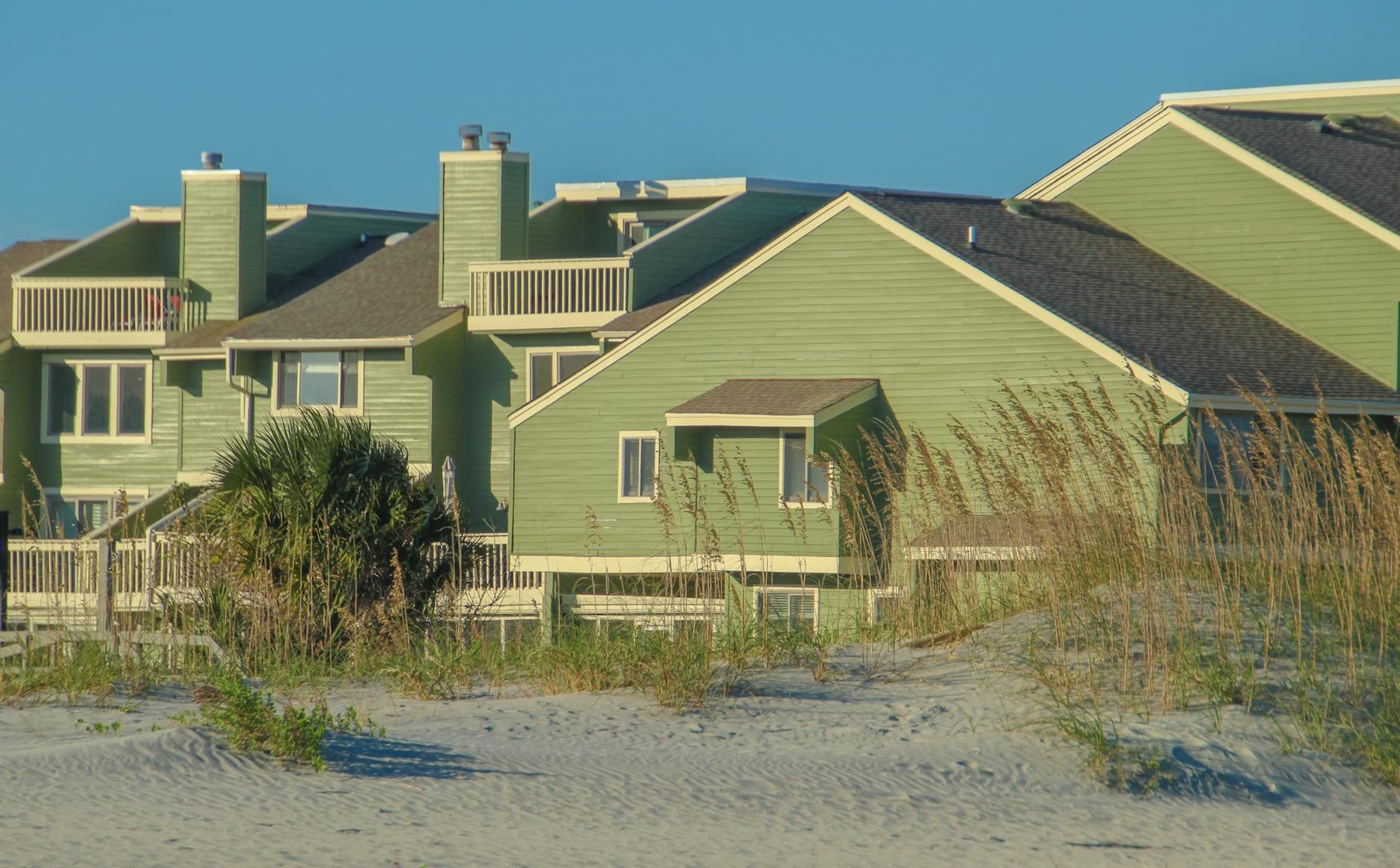
Owning a piece of paradise has always been a powerful dream — a mountain cabin where the family gathers every winter, a beach cottage that pays for itself between visits, or a lake house that doubles as a retirement rehearsal. In 2026, that dream is more attainable than it was during the frenzied pandemic buying years, but it’s also more complicated. Mortgage rates have settled into a new normal that looks nothing like 2021, short-term rental regulations have tightened in hundreds of cities, and the gap between what a vacation property feels like it should cost and what it actually costs in total ownership has caught many buyers off guard. This guide walks you through every layer of the financial picture — from the first conversation with a lender to the annual stress test that tells you whether you should stay the course or sell.
Second-Home vs. Investment Property Mortgages
The first decision that shapes your entire financial model is how you intend to use the property, because lenders treat second homes and investment properties very differently — and those differences compound over the life of the loan.
A second home, in lender language, is a property you personally occupy for a meaningful portion of the year, is not subject to rental management agreements, and is typically located a reasonable distance from your primary residence. As of mid-2026, second-home mortgage rates are running roughly 0.25 to 0.75 percentage points above a comparable primary residence rate. On a $500,000 loan, that spread translates to roughly $80–$250 more per month in interest cost, which adds up to $1,000–$3,000 annually.
An investment property mortgage, used when the primary purpose is generating rental income, carries a larger premium — typically 0.50 to 1.25 percentage points above primary residence rates. Lenders price this higher because data consistently shows that distressed borrowers prioritize their primary home over an investment asset. The practical difference between a second-home and investment property rate, even at the low end of both ranges, can be $150–$400 per month on a mid-sized loan.
Down payment requirements reflect the same risk logic. Second homes generally require 10–15% down with strong credit, while investment properties typically require 15–25% down, and many conventional lenders sit at 20–25% for investment loans as their standard threshold. That distinction is worth internalizing early: a $600,000 vacation property might require $60,000 down as a second home or $120,000 as an investment property — before closing costs.
One important nuance: lenders do not simply take your word on classification. If you list the property on Airbnb full-time, have a professional management agreement in place before closing, or buy in a known resort rental market with no evidence of personal use, an underwriter may reclassify your loan as investment property mid-process. Misrepresenting a rental property as a second home to capture better rates is mortgage fraud. The line is real, and crossing it intentionally carries serious legal consequences.
Full Ownership Costs: The Number You Actually Need
The mortgage payment is the most visible cost, but it routinely represents only 55–70% of true ownership expense. Buyers who model just the mortgage frequently experience sticker shock in year two.
Property taxes vary wildly by state and county, but vacation markets often carry full market-value assessments without the homestead exemptions that soften primary residence bills. In popular Florida beach markets, effective tax rates of 0.8–1.2% on assessed value are common. On a $700,000 property, that’s $5,600–$8,400 per year before any adjustments.
Insurance is where the 2026 landscape has genuinely changed. Coastal and wildfire-adjacent markets have seen homeowners insurance premiums surge 30–60% over the past three years as major carriers have exited states like Florida and California. A Gulf Coast vacation home that cost $3,500/year to insure in 2020 may now run $7,000–$12,000, and flood insurance through FEMA’s NFIP or private markets adds another $1,500–$6,000 depending on flood zone designation. Before making an offer, obtain an insurance quote for the specific property. Do not estimate.
HOA fees in resort communities, condo buildings, and planned developments frequently run $400–$1,200 per month. High-end ski condo associations in Colorado or beachfront buildings in Hawaii can exceed $2,000/month. These fees rarely decrease and often include special assessment exposure for deferred infrastructure work.
Maintenance on a vacant or semi-occupied property runs higher per square foot than a full-time residence. A standard budgeting rule is 1–2% of property value annually, but vacation homes exposed to weather extremes, saltwater air, or heavy rental use should be budgeted at 2–3%. On a $600,000 property, that’s $12,000–$18,000 per year set aside for repairs, appliances, HVAC, pest control, landscaping, and capital expenditures.
Utilities for a property you use intermittently are surprisingly persistent. Even when vacant, you’ll pay for water, electricity (often running at minimum to prevent pipe freezes or humidity damage), internet for a smart thermostat or security system, and trash service. Budget $200–$500/month depending on climate and property size, even with minimal personal use.
Property management, if you rent the home, typically runs 25–35% of gross rental revenue for full-service management that handles booking, guest communication, cleaning coordination, and maintenance oversight. Boutique managers in high-demand markets sometimes charge less; managers in remote or lower-demand areas may charge more, or may not exist at all.
Putting it together, a $700,000 vacation home financed at 80% with a 7% rate carries a principal-and-interest payment around $3,720/month. Add $650 for taxes, $800 for insurance, $600 for HOA, $1,200 in annualized maintenance reserves, and $350 in utilities: total monthly cost approaches $7,320 — nearly double the mortgage payment alone.
Rental Income Reality
The vacation rental industry normalized aggressive income projections during the Airbnb boom years, and some of those projections have not aged well. Understanding occupancy economics in 2026 requires intellectual honesty.
Occupancy rates for short-term rentals nationally average around 50–60% for well-managed properties in established markets, according to data from AirDNA. Top performers in high-demand markets (think Smoky Mountains, Florida Keys, Lake Tahoe) can reach 70–75%, but these are the exception. New listings in saturated markets may see 35–45% in their first year as they build reviews and visibility.
Seasonal concentration is a structural feature of vacation rental income, not a bug you can optimize away. A mountain ski property might earn 60% of its annual income in 12 weeks. A beach house might earn 65% from Memorial Day through Labor Day. This means cash flow is lumpy — strong in peak months, potentially negative in shoulder seasons when income doesn’t cover operating costs. Your financial model needs to survive January even if July is excellent.
Platform fees eat a meaningful share of revenue. Airbnb charges hosts 3% on most listings; Vrbo charges 5% on the pay-per-booking model or an annual subscription. But these baseline fees don’t capture the full picture. Payment processing, smart pricing tools, professional photography, listing management software, and channel distribution platforms often add another 2–5% of revenue in aggregate.
Net rental income, after platform fees and property management (if applicable), typically represents 50–60% of gross booking revenue. A property earning $60,000 gross in bookings may net $30,000–$36,000 before tax, debt service, or capital expenditure recovery.
Tax Treatment
Federal tax law offers real benefits to vacation home owners, but the rules are precise and the penalty for getting them wrong — in the form of disallowed deductions and back taxes — is expensive.
The pivotal dividing line is the 14-day rule under IRC Section 280A. If you personally use the property for more than 14 days per year or more than 10% of the days it’s rented at fair market value (whichever is greater), the IRS considers it a personal residence with limited rental activity. In that scenario, you deduct rental expenses only up to the amount of rental income — you cannot create a deductible loss, and the home’s portion of expenses is split between personal and rental use.
If you rent the property for fewer than 15 days per year, rental income is entirely tax-free — a little-known provision that benefits owners of high-demand properties near major events — but you also cannot deduct any rental expenses.
If the property is rented more than 14 days per year and personal use stays at or below the 14-day/10% threshold, the property qualifies as a rental under Schedule E. This is the preferred tax position for active investors. On Schedule E, you deduct mortgage interest, property taxes, insurance, HOA fees, management fees, repairs, utilities, and — most powerfully — depreciation. Residential rental property is depreciated over 27.5 years. On a $700,000 property with $100,000 allocated to land, the annual depreciation deduction is roughly $21,800, which can significantly reduce taxable rental income or, for qualifying active real estate participants, offset other income.
Properties used primarily personally and rented incidentally deduct mortgage interest on Schedule A as a second-home mortgage (subject to the $750,000 debt limit for post-2017 mortgages), and property taxes up to the $10,000 SALT cap.
Consult a CPA with vacation rental experience before your first rental night, not after your first tax season. Proper record-keeping of personal vs. rental use days from day one is essential.
Local Regulation Risks
In 2026, one of the most underappreciated risks in vacation property ownership is regulatory. Hundreds of municipalities have passed short-term rental (STR) restrictions since 2019, and the trend has accelerated. Some cities — including New York City, which effectively ended most STR activity through its registration laws, and Santa Monica — have enacted near-total bans on whole-home rentals. Others have capped STR density by neighborhood, required owner-occupancy, imposed permit lotteries with multi-year wait lists, or passed Hotel/Motel Use Taxes (HUT) that increase effective operating costs.
Before purchasing in any market with STR intent, verify: whether the property’s specific zoning permits STR activity, whether a permit is available (not just theoretically permitted), what licensing costs and renewal requirements apply, and what the trajectory of local regulation has been over the past three years. City councils in high-housing-cost markets are under sustained political pressure to restrict vacation rentals, and a property that is legally operable today may not be in three years.
This is not hypothetical risk — investors in Barcelona, Sedona, and Scottsdale have seen STR income collapse following regulatory changes after purchase. A title search tells you who owns the property; a regulatory due diligence review tells you what you can legally do with it.
Stress Testing the Math at 60% Occupancy
Before committing, run this stress test. It’s deliberately conservative and designed to find the failure points before you sign, not after.
Establish your gross annual rental income at 60% occupancy. Multiply your target nightly rate by 365, then by 0.60. If the property can reasonably command $300/night: $300 × 365 × 0.60 = $65,700 gross.
Apply a platform and management haircut of 35% (platform fees, management, cleaning): $65,700 × 0.65 = $42,705 net operating income before debt and taxes.
Now subtract annual ownership costs excluding the mortgage: $7,800 taxes + $9,600 insurance + $7,200 HOA + $14,000 maintenance reserve + $4,200 utilities = $42,800 in annual non-debt costs.
On a $600,000 financed amount at 7% over 30 years, annual principal and interest = approximately $47,900.
Total annual outflows: $42,800 + $47,900 = $90,700. Net after rental income: $90,700 − $42,705 = $47,995 annual shortfall — roughly $4,000/month out of pocket.
That number is not automatically disqualifying. If this is primarily a personal use property and you’re comfortable subsidizing it for lifestyle value, $4,000/month may be acceptable. But if your plan assumed the property would break even or cash flow positively at 60% occupancy, this stress test reveals the gap clearly.
Adjust the inputs for your specific property. The goal is not to talk yourself out of buying — it’s to ensure that when reality diverges from projection (and it will), you’ve already modeled it.
Bringing It All Together
Buying a vacation home in 2026 is a decision that rewards preparation and penalizes assumptions. The buyers who thrive are those who secured the right loan classification from the start, modeled total ownership costs rather than just the mortgage, built conservative rental income projections, understood the tax rules before day one, verified regulatory status in their target market, and ran an honest stress test with the numbers they actually have — not the ones they hope for. If that full picture still makes sense, both financially and personally, a vacation property can be one of the most rewarding assets you’ll ever own.
Sources and Further Reading
- AirDNA – Short-Term Rental Market Reports: airdna.co — occupancy rate data and market analytics
- IRS Publication 527 – Residential Rental Property: irs.gov/pub527 — authoritative guidance on the 14-day rule, Schedule E, and depreciation
- IRS Section 280A: irs.gov — personal use vs. rental use rules
- FEMA National Flood Insurance Program: floodsmart.gov — flood insurance cost estimates by zone
- Fannie Mae Second Home vs. Investment Property Guidelines: fanniemae.com — loan classification rules and down payment requirements
- VRBO Host Fee Structure: vrbo.com/info/host-resources — current platform fee schedules
- Airbnb Host Fee Structure: airbnb.com/help/article/1857 — service fee breakdown for hosts
- Insurance Information Institute – Homeowners Trends: iii.org — premium trend data and carrier exit reporting
- National Association of Realtors – Vacation Home Market Report: nar.realtor — annual second-home buyer profile data
