
Electric vs Hybrid: Which Is Right for Your Daily Commute?
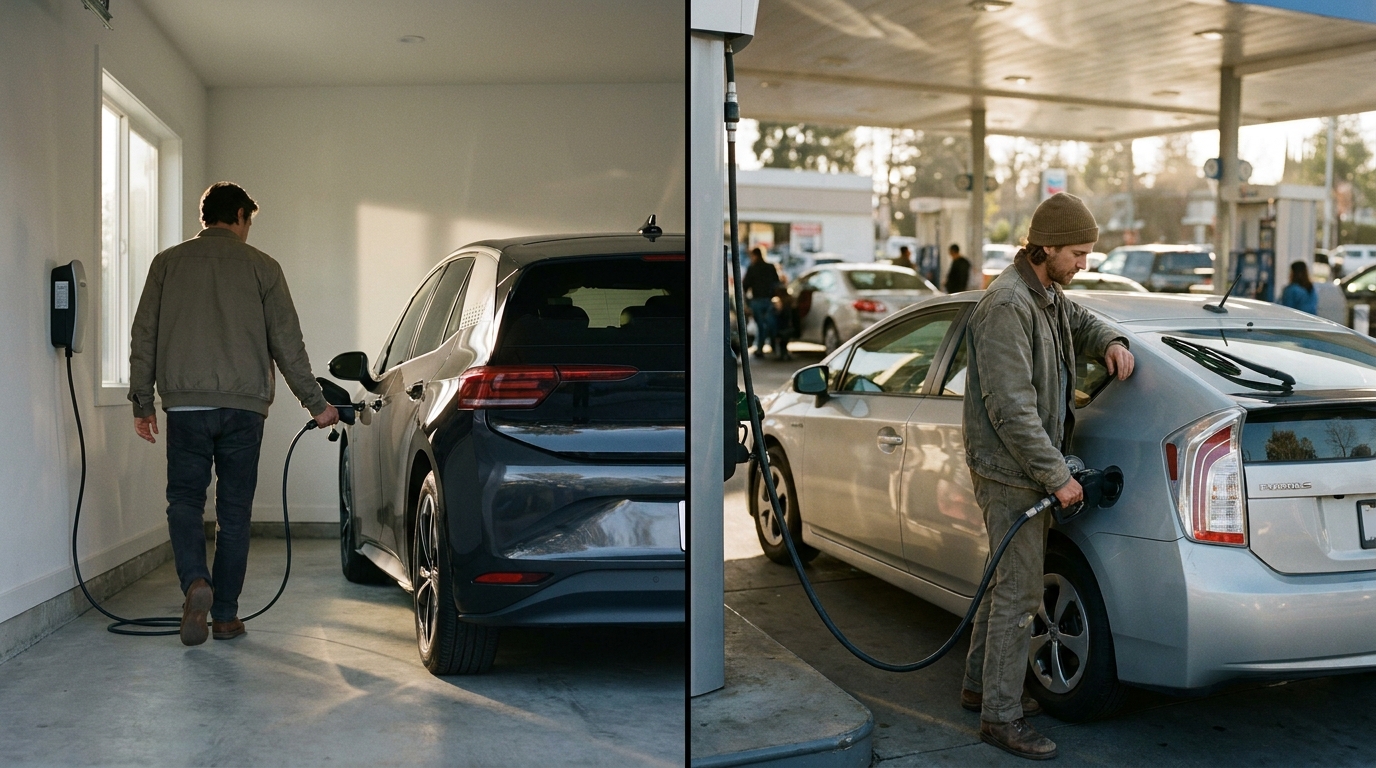
Electric vehicles and hybrids are both compelling alternatives to traditional gas-powered cars, but choosing between them for daily commuting is rarely straightforward. The decision involves layered trade-offs across upfront cost, incentive eligibility, charging infrastructure, long-term savings, and how well each technology fits your specific driving patterns. As both markets mature rapidly heading into 2026, the gap between EVs and hybrids is shifting in ways that make the comparison more nuanced than ever.
Purchase Price Gap
The sticker price difference between EVs and hybrids remains meaningful, though it has narrowed considerably. As of early 2025, the average transaction price for a new battery electric vehicle (BEV) sits around $55,000, while the average hybrid — including both standard hybrids (HEVs) and plug-in hybrids (PHEVs) — lands closer to $35,000–$42,000, depending on the segment.
Entry-level EVs like the Chevrolet Equinox EV start around $34,995, and the Nissan Leaf can be found near $28,000, making EVs increasingly accessible. However, mass-market hybrids still undercut them: the Toyota Camry Hybrid starts around $31,900, and the wildly popular Toyota RAV4 Hybrid begins near $33,000. Plug-in hybrids such as the Toyota RAV4 Prime start around $43,000, blurring the line between the two categories.
For budget-conscious commuters, hybrids typically offer a lower entry point, and because they don’t require home charging equipment, they also avoid the $500–$2,000 cost of Level 2 charger installation — a hidden expense that many EV buyers underestimate.
2026 Federal and State Incentives
Incentives play a major role in the true cost equation, and the landscape in 2026 continues to evolve under the framework established by the Inflation Reduction Act (IRA).
For EVs, the federal tax credit of up to $7,500 (for new vehicles) or $4,000 (for used vehicles) remains available, but with important income and MSRP caps. Buyers must have a modified adjusted gross income below $150,000 (single) or $300,000 (joint), and the vehicle must have a final assembly in North America with battery sourcing meeting strict domestic content thresholds. As of 2025, the credit can now be applied at the point of sale — meaning dealers can reduce the purchase price directly rather than requiring buyers to wait for a tax return.
For PHEVs, the same $7,500 credit can apply, provided the vehicle meets battery capacity and sourcing requirements. Standard hybrids (non-plug-in) do not qualify for the federal EV credit.
At the state level, incentives vary widely. California’s Clean Vehicle Rebate Project has transitioned to the Clean Cars 4 All program focusing on lower-income buyers, while states like Colorado offer up to $5,000 in state EV credits on top of the federal amount. Some states — including Texas and Florida — offer minimal or no EV incentives. A comprehensive state-by-state breakdown can be found through the Department of Energy’s Alternative Fuels Station Locator and Incentives Tool at afdc.energy.gov.
For the right buyer in the right state, an EV’s effective purchase price can be reduced by $7,500–$12,500 or more, potentially closing — or even reversing — the price gap with comparable hybrids.
Real-World Range
Manufacturer range figures are consistently optimistic, and real-world performance reflects road conditions, driving style, climate, and load.
Most mainstream EVs rated for 250–300 miles of EPA range deliver roughly 210–260 miles in mixed real-world driving. Cold weather performance is a particular concern: EVs can lose 20–40% of range in temperatures below 20°F, according to studies by the American Automobile Association (AAA). Highway speeds above 70 mph also degrade range meaningfully, often dropping efficiency by 15–25%.
Hybrids, by contrast, operate with the gasoline engine as a backstop, so range anxiety is virtually nonexistent. A standard hybrid like the Toyota Prius achieves around 50 MPG combined, giving it a real-world range of 550+ miles per tank. PHEVs offer the best of both: the Hyundai Tucson PHEV, for example, provides roughly 33 miles of electric-only range before seamlessly transitioning to hybrid operation.
For commuters whose daily distance comfortably fits within EV range, this distinction is largely theoretical. But for those who drive frequently in extreme weather or have variable daily distances, the hybrid’s operational flexibility is a genuine advantage.
Public Charging Coverage
The U.S. public charging network is expanding rapidly. As of 2025, there are over 192,000 public charging ports across the country, with the number growing significantly as the National Electric Vehicle Infrastructure (NEVI) Formula Program funds highway corridor chargers in every state. Tesla’s Supercharger network — now open to many non-Tesla vehicles — adds substantial fast-charging capacity, especially in urban and suburban corridors.
Despite progress, charging gaps persist in rural areas, older apartment complexes, and many urban neighborhoods where residents rely on street parking and cannot install home chargers. For these commuters, EV ownership creates real logistical challenges.
Hybrids, fueled at any of the country’s 145,000+ gas stations, face no infrastructure concern whatsoever. PHEVs benefit from public charging when available but are not dependent on it. This infrastructure asymmetry still favors hybrids for drivers without reliable home charging access, though it is narrowing each year.
5-Year Cost of Ownership
When purchase price, incentives, fuel, and maintenance are factored together over five years, EVs increasingly come out ahead — particularly for high-mileage commuters.
Fuel savings are the primary driver. Electricity costs roughly $0.04–0.06 per mile in most U.S. markets (assuming home charging at average national electricity rates near $0.16/kWh), while gasoline at $3.20–$3.60/gallon costs the average hybrid owner $0.07–0.09 per mile. For a driver covering 15,000 miles per year, this translates to roughly $450–$750 in annual fuel savings for an EV owner.
A 5-year analysis for a mid-range EV versus a comparable PHEV (after applying federal incentives) typically shows the EV saving $3,000–$6,000 in total cost of ownership, according to analyses by Consumer Reports and the Rocky Mountain Institute. However, this depends heavily on local electricity rates, gas prices, annual mileage, and whether the full federal tax credit was captured.
Higher-mileage drivers benefit more from EV economics. Lower-mileage drivers may not recoup the EV’s premium over a hybrid within five years.
Maintenance Differences
EVs have fundamentally simpler drivetrains. They eliminate oil changes, timing belts, spark plugs, transmission fluid, and exhaust system components. The primary maintenance costs for EVs involve tire rotation, brake fluid, cabin air filters, and eventual battery health checks. Regenerative braking also means brake pads last significantly longer than on conventional vehicles.
Consumer Reports data consistently shows EV owners spending less on maintenance — approximately $0.03 per mile compared to $0.06 per mile for internal combustion vehicles.
Hybrids occupy the middle ground. Standard hybrids still require all conventional engine maintenance — oil changes, spark plugs, belts — though less frequently in some cases due to lower engine use. PHEVs add a small battery pack that requires occasional monitoring. Overall, hybrids cost more to maintain than EVs but less than pure gasoline vehicles.
Over five years and 75,000 miles, the maintenance savings for an EV over a hybrid typically amount to $1,500–$2,500.
Resale Trends
EV resale values have experienced significant volatility in recent years, largely driven by rapid model updates, falling new EV prices (particularly from Tesla and emerging Chinese-brand competition), and uncertainty around battery longevity. As of 2025, many EVs depreciate faster than comparable hybrids, with some models losing 40–50% of value within three years.
Hybrids, particularly Toyota hybrids, have shown exceptional resale performance — the RAV4 Hybrid and Prius consistently rank among the highest resale value vehicles in their segments, sometimes retaining 60–65% of value after three years.
This is a meaningful consideration for buyers who plan to sell or trade within five years. If EV new car prices continue to fall, used EV values may face continued downward pressure. PHEV resale has been more stable than BEVs, sitting between hybrids and pure EVs on the depreciation curve.
Three Commuter Scenarios
Scenario 1: 15-Mile City Commute
For an urban commuter driving 15 miles round-trip daily with access to home charging, an EV is an excellent fit. Fuel costs are minimal, charging happens overnight, and the vehicle almost never needs a public charger. The maintenance savings compound meaningfully, and incentives reduce the upfront gap. The main risk is resale depreciation if the commuter plans to upgrade frequently.
Best choice: EV, especially a smaller, lower-cost model like the Chevy Equinox EV or Tesla Model 3.
Scenario 2: 40-Mile Suburban Commute
A suburban driver covering 40 miles daily has several good options. A PHEV like the Toyota RAV4 Prime (33 miles of EV range) can cover most of the commute electrically while offering gas backup for longer weekend trips. A fully electric SUV works well too, provided home charging is available. At this distance, the annual fuel savings from an EV begin to add up significantly.
Best choice: PHEV or EV, depending on home charging availability and whether long road trips are frequent. The PHEV offers the most flexibility.
Scenario 3: 80-Mile Highway Commute
An 80-mile daily highway commute places heavy demands on any vehicle. An EV can technically handle it — most mainstream EVs would cover an 80-mile round trip comfortably — but highway efficiency is lower, real-world range margins shrink, and frequent high-mileage use means batteries cycle more intensively. Unless reliable workplace charging is available, some commuters at this range may want the reassurance of a hybrid.
That said, a long-range EV like the Tesla Model Y Long Range (EPA: 330 miles) handles this comfortably. A hybrid, meanwhile, excels here with effortless range — the Hyundai Elantra Hybrid returns 50+ MPG even at highway speeds.
Best choice: Long-range EV (if workplace charging or sufficient home-charging time is available) or highway-efficient hybrid like the Hyundai Elantra Hybrid or Toyota Camry Hybrid for maximum simplicity.
Decision Framework
Use these questions to guide your choice:
- Do you have reliable home charging access? If no, lean strongly toward a hybrid or PHEV.
- What is your annual mileage? Above 15,000 miles/year, EV fuel savings compound quickly. Below 10,000 miles, the economics favor a hybrid.
- Do you qualify for the federal tax credit? If yes, recalculate the EV’s effective price — it may be lower than you expect.
- What are your state’s incentives? Check afdc.energy.gov to determine if additional credits are available.
- Do you frequently make long road trips? If so, a PHEV or hybrid provides maximum flexibility without charging logistics.
- How long do you plan to own the vehicle? The longer you hold it, the more EV maintenance savings and fuel economics work in your favor.
- Is resale value a priority? Toyota hybrids currently lead in retained value; EVs carry more depreciation risk in the near term.
For most suburban commuters with home charging, a PHEV represents the most pragmatic middle ground in 2026 — capturing electric efficiency for daily driving while eliminating range and infrastructure anxiety entirely. Pure EV adoption makes the most financial sense for high-mileage drivers with reliable home charging and access to federal incentives. Standard hybrids remain the smart choice for anyone seeking simplicity, low maintenance, excellent fuel economy, and strong resale performance without any charging infrastructure dependency.
Sources and References
- U.S. Department of Energy – Alternative Fuels Data Center (incentives and charging): afdc.energy.gov
- IRS – Clean Vehicle Credits under the Inflation Reduction Act: irs.gov/credits-deductions/clean-vehicle-tax-credits
- AAA – Cold Weather EV Range Study: aaa.com
- Consumer Reports – EV Maintenance Cost Data: consumerreports.org
- Rocky Mountain Institute – EV Cost of Ownership Analysis: rmi.org
- Kelley Blue Book – Average EV and Hybrid Transaction Prices: kbb.com
- NEVI Program – Federal Highway Administration: fhwa.dot.gov/environment/alternative_fuel_corridors
