
All-Season vs. Winter Tires: Which Do You Really Need
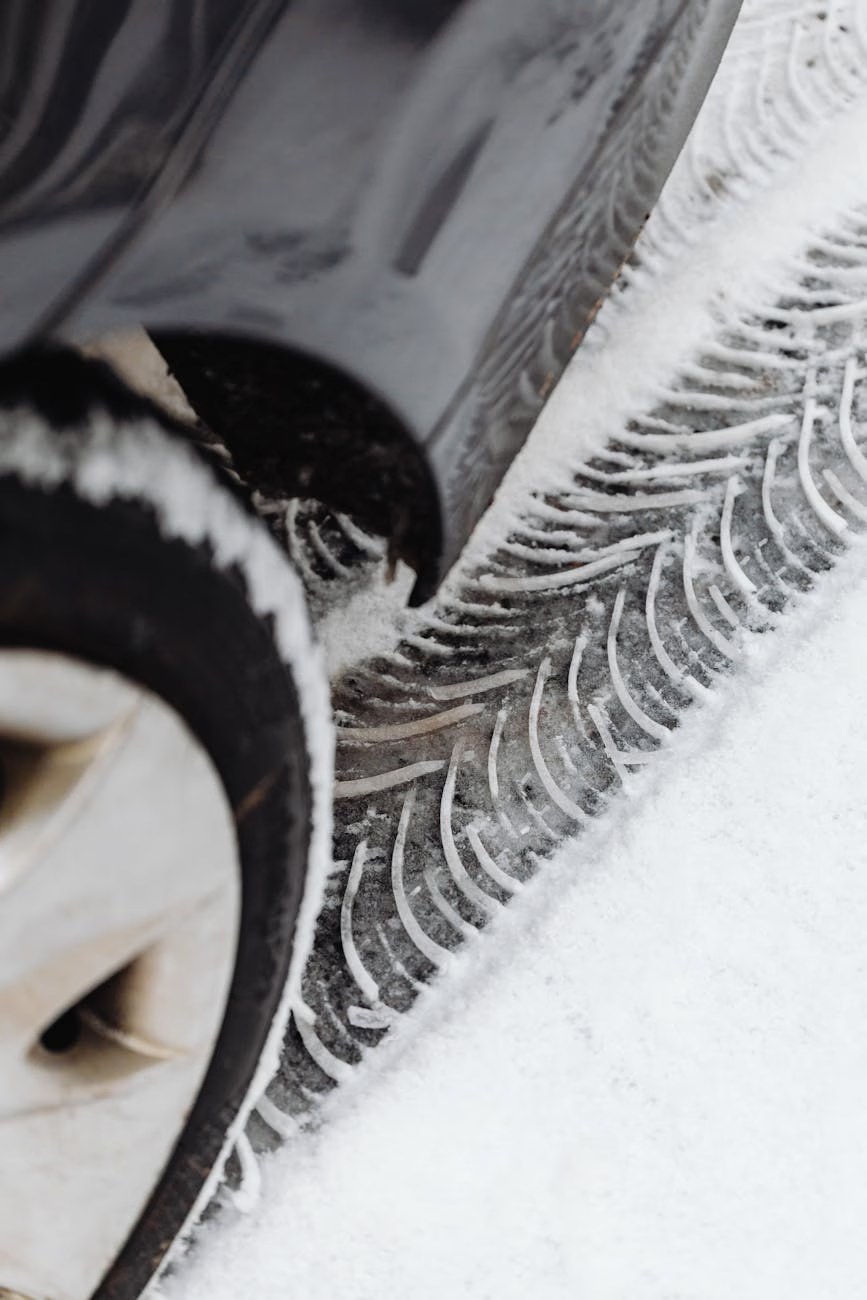
Winter tires are one of those automotive investments that generate genuine debate. Some drivers swear by them; others consider them an unnecessary expense for anyone who doesn’t live in the snowbelt. The truth, as with most things in vehicle safety, lies in the data—and the data is more compelling than most all-season tire marketing would have you believe.
This guide breaks down everything a safety-conscious driver needs to make an informed decision: how the rubber chemistry actually differs, what stopping distance tests reveal, how to calculate the real five-year cost, and exactly when your climate justifies the investment.
How Tire Compounds Differ Between All-Season and Winter Designs
The fundamental difference between all-season and winter tires isn’t tread pattern—it’s chemistry. All-season tires use a rubber compound engineered to perform across a broad temperature range, roughly 32°F (0°C) and above. Below that threshold, the compound begins to harden, losing the pliability needed to conform to road irregularities and generate traction.
Winter tires use a high-silica rubber compound that remains soft and pliable at temperatures as low as -40°F (-40°C). Silica, a fine silicon dioxide powder, acts as a plasticizer within the rubber matrix, keeping the compound supple even in extreme cold. This isn’t a marginal difference—at 14°F (-10°C), an all-season tire has hardened to the point where its contact patch is effectively acting like a hockey puck dragging across pavement.
Beyond compound, winter tires feature sipes—thousands of tiny slits cut into the tread blocks—that create biting edges for ice and compressed snow. The tread patterns are also designed with wider, more open grooves to evacuate slush and prevent snow packing. Some premium winter tires incorporate a micro-porous tread design that absorbs and evacuates a thin film of meltwater between the tire and ice surface, the same mechanism that allows ice skates to glide.
All-season tires are a genuine engineering compromise. They handle dry summer pavement better than winter tires do, and they perform acceptably in light rain. But “all-season” is a marketing term, not a safety certification. In the tire industry, these products are sometimes called “three-season tires” by engineers who are being candid.
Stopping Distance Tests and What the Data Shows
The most sobering data in the winter tire discussion comes from controlled stopping distance tests. Multiple independent organizations—including the Quebec automobile safety association CAA-Quebec, Tire Rack, and Transport Canada—have conducted instrumented testing that quantifies the real-world difference.
In a representative CAA-Quebec test, a vehicle traveling at 50 km/h (31 mph) on snow-packed road required 38.6 meters to stop on all-season tires. The same vehicle on winter tires stopped in 28.5 meters—a difference of more than 10 meters. At 50 km/h, that gap is roughly the length of two car lengths, which is the difference between avoiding a collision and not.
Tire Rack’s testing on ice at 20 mph (32 km/h) found even more dramatic differences. Winter tires outperformed all-season tires by as much as 30 to 40 feet in stopping distance—a 25% reduction. Critically, all-wheel drive had essentially no effect on stopping distance in these tests. AWD improves acceleration traction but does almost nothing for braking performance, a distinction that many SUV and crossover owners dangerously misunderstand.
The Consumer Reports annual tire testing program has consistently found that winter tires provide stopping distances 20 to 30 percent shorter than all-season tires on snow and ice. These aren’t outlier results from a single lab—they replicate across methodologies and organizations. If you are a parent transporting children in a vehicle that regularly encounters sub-freezing temperatures, this data deserves serious weight in your decision-making.
The Real Cost of Owning Two Sets of Tires
The cost objection to winter tires is legitimate and worth analyzing carefully. The full picture, however, often surprises drivers who do the five-year math.
Initial investment: A set of four mid-range winter tires (e.g., Michelin X-Ice Snow, Bridgestone Blizzak WS90) runs approximately $600 to $900 for a passenger car, or $800 to $1,200 for a light truck or SUV. Mounting and balancing adds $80 to $120. If you purchase a second set of steel rims—strongly recommended to simplify seasonal swaps—expect to pay $200 to $400 for a set of four, depending on vehicle fitment.
Total Year 1 investment: Approximately $900 to $1,600 depending on tire grade and rim choice.
Where the math gets interesting: Because you’re now running two sets of tires alternately, each set wears at roughly half the rate. The average driver puts about 15,000 miles per year on their vehicle. If winter conditions prevail for five months, you’re putting approximately 6,250 miles per year on your winter tires and 8,750 on your all-seasons. Both sets last significantly longer than a single set used year-round.
A quality all-season tire rated for 60,000 miles, used year-round, is replaced roughly every four years at 15,000 miles annually. With seasonal rotation, that same tire might last six to seven years. Your winter tires, typically rated for 40,000 to 50,000 miles of tread life, will similarly last four to six winter seasons.
Five-year cost-of-ownership model:
| Scenario | Year 1 | Year 2–5 | 5-Year Total |
|---|---|---|---|
| All-seasons year-round (replacement at Year 4) | $700 | $175/yr + $700 at Yr 4 | ~$1,500 |
| Winter + All-season with steel rims | $1,400 | $80/yr (storage/swap) | ~$1,720 |
The premium for genuine winter safety over five years works out to roughly $44 per year, or about $3.67 per month. That figure excludes the potential insurance benefit—some Canadian provinces offer discounts of 2 to 5% for vehicles equipped with winter tires, and some U.S. insurers are beginning to follow suit. It also excludes the cost of even a minor collision that winter tires might have prevented.
What Climate Threshold Makes Winter Tires Worth It
The most practical decision framework centers on a simple temperature rule: if your average daily temperature drops below 45°F (7°C) for more than 60 days per year, winter tires deliver measurable safety benefit. Below 45°F, the rubber compound differentiation becomes significant even on dry pavement, not just in snow.
Climate-zone decision framework:
- Zone 1 – Clear benefit: Cities averaging more than 60 days below 45°F, significant snowfall (more than 20 inches annually), or regular icing events. Examples: Minneapolis, Buffalo, Denver, Montreal, Calgary, Chicago, Boston. Winter tires are strongly recommended.
- Zone 2 – Situational benefit: Cities with 30 to 60 days below 45°F, occasional snow events, and frequent overnight freezing with daytime thaw cycles. Examples: Seattle, Portland, Nashville, Washington D.C., Kansas City, northern Virginia. Winter tires are a reasonable investment, particularly for drivers with longer commutes, hilly terrain, or families with young children.
- Zone 3 – Marginal benefit: Cities rarely seeing sustained below-freezing temperatures. Examples: Atlanta, Dallas, Los Angeles, Phoenix. All-season tires are generally adequate; a set of dedicated winter tires is hard to justify economically.
One important caveat for Zone 2 and Zone 3 cities: the freeze-thaw cycle is often more dangerous than consistent deep cold. Black ice forms readily when daytime melt refreezes overnight, and drivers in these climates may have less experience handling slick conditions than those in Zone 1 cities. If you live in Zone 2 and regularly travel mountain passes or rural roads, treat your climate as Zone 1.
How to Store Off-Season Tires Properly
Improper storage degrades tires faster than seasonal use does. Done correctly, your off-season set will retain full performance for six to eight years.
Key storage principles:
Clean before storing. Wash tires with mild soap and water, removing road grime, brake dust, and any petroleum-based chemicals that degrade rubber. Allow them to dry completely before storage.
Avoid UV exposure and ozone sources. Ozone and ultraviolet light cause rubber oxidation. Store tires away from fluorescent lights, electric motors (which produce ozone), furnaces, and direct sunlight. A dark basement or climate-controlled garage space is ideal.
Use tire storage bags. Individual airtight plastic bags—available for $15 to $30 per set—limit oxygen exposure, slowing oxidative aging. This is the single most impactful storage upgrade you can make.
Store vertically or stacked. Unmounted tires can be stored upright (vertical) or stacked horizontally. Mounted tires on rims should be stored vertically if possible; stacking mounted tires flat for extended periods can stress sidewalls. If horizontal stacking is the only option, rotate the stack position monthly.
Temperature and humidity. Cool, dry, and stable is the goal. Avoid uninsulated outdoor sheds where tires experience extreme temperature swings. Ideal storage temperature is between 32°F and 77°F (0°C to 25°C).
Choosing the Right Winter Tire for Your Vehicle Type
Not all winter tires are optimized for the same conditions, and vehicle type significantly affects which product performs best.
Passenger cars and small crossovers are well served by studless ice and snow tires—the dominant category in North America. Products like the Michelin X-Ice Snow, Bridgestone Blizzak WS90, and Continental WinterContact SI offer excellent balanced performance on packed snow, ice, and wet pavement. The Blizzak WS90 historically leads independent ice stopping distance tests; the X-Ice Snow provides superior tread life.
SUVs and trucks require load-rated winter tires matched to the vehicle’s weight. The Nokian Hakkapeliitta R5 SUV and the Goodyear WinterCommand Ultra are strong options. Avoid using passenger-car winter tires on trucks or large SUVs—they are not engineered for the additional load and can degrade unpredictably.
Performance vehicles should look at ultra-high-performance winter tires such as the Michelin Pilot Alpin 5 or Continental WinterContact TS 870 P. These are engineered to maintain handling responsiveness in cold conditions while still delivering winter traction—standard winter tires sacrifice dry handling characteristics that matter in a sports car or performance sedan.
Studded tires remain an option in most northern U.S. states and Canadian provinces, though they’re banned or restricted in some jurisdictions. They offer superior ice traction but produce more road noise and cause pavement wear. For most urban and suburban drivers, modern studless designs have closed the gap significantly, and studded tires are now primarily recommended for remote rural drivers or those regularly encountering severe glaze ice.
The rim swap tutorial: Purchasing a second set of steel or alloy rims pre-mounted with your winter tires is the single most practical upgrade for making seasonal changes sustainable. With two mounted sets, a seasonal changeover requires a torque wrench, a floor jack, and 45 to 60 minutes—no professional tire mounting fees, no scheduling appointments, no waiting. Simply jack the vehicle, swap the wheels, torque to spec (check your owner’s manual, typically 80 to 120 ft-lbs), and drive. Most drivers who make this switch report that the reduced friction of seasonal swaps is what actually keeps them consistent about changing tires at the right time each year. Steel rims are the cost-effective choice; they’re more durable against curb damage and road salt corrosion than alloy, and they won’t be seen under winter wheel wells anyway.
The bottom line: Winter tires aren’t a luxury accessory—they’re a rubber-chemistry solution to a physics problem. The stopping distance data is unambiguous, the five-year cost premium is modest, and the climate framework above gives you a clear framework to assess your own situation honestly. For Zone 1 and most Zone 2 drivers with families or significant cold-weather commutes, the question isn’t really whether winter tires are worth it. It’s why you haven’t already made the switch.
Sources and Further Reading
- CAA-Quebec Winter Tire Stopping Distance Study: https://www.caaquebec.com/en/on-the-road/advice/winter-tires/
- Tire Rack Winter Tire Testing and Reviews: https://www.tirerack.com/tires/tests/testarchive.jsp
- Transport Canada Tire Safety Information: https://tc.canada.ca/en/road-transportation/safety-regulations-compliance-enforcement/vehicle-safety/tire-safety
- Consumer Reports Tire Ratings and Testing Methodology: https://www.consumerreports.org/tires/
- Michelin X-Ice Snow (pricing and specs): https://www.michelinman.com/tires/michelin/x-ice-snow
- Bridgestone Blizzak WS90 (pricing and specs): https://www.bridgestonetire.com/tires/blizzak/
- Nokian Hakkapeliitta R5 SUV: https://www.nokiantires.com/winter-tires/nokian-hakkapeliitta-r5-suv/
- Quebec government winter tire insurance discount program: https://www.revedirnordsud.com/en/winter-tires-insurance-discount/
