
Electric Vehicle Ownership: Costs, Benefits, and Realities
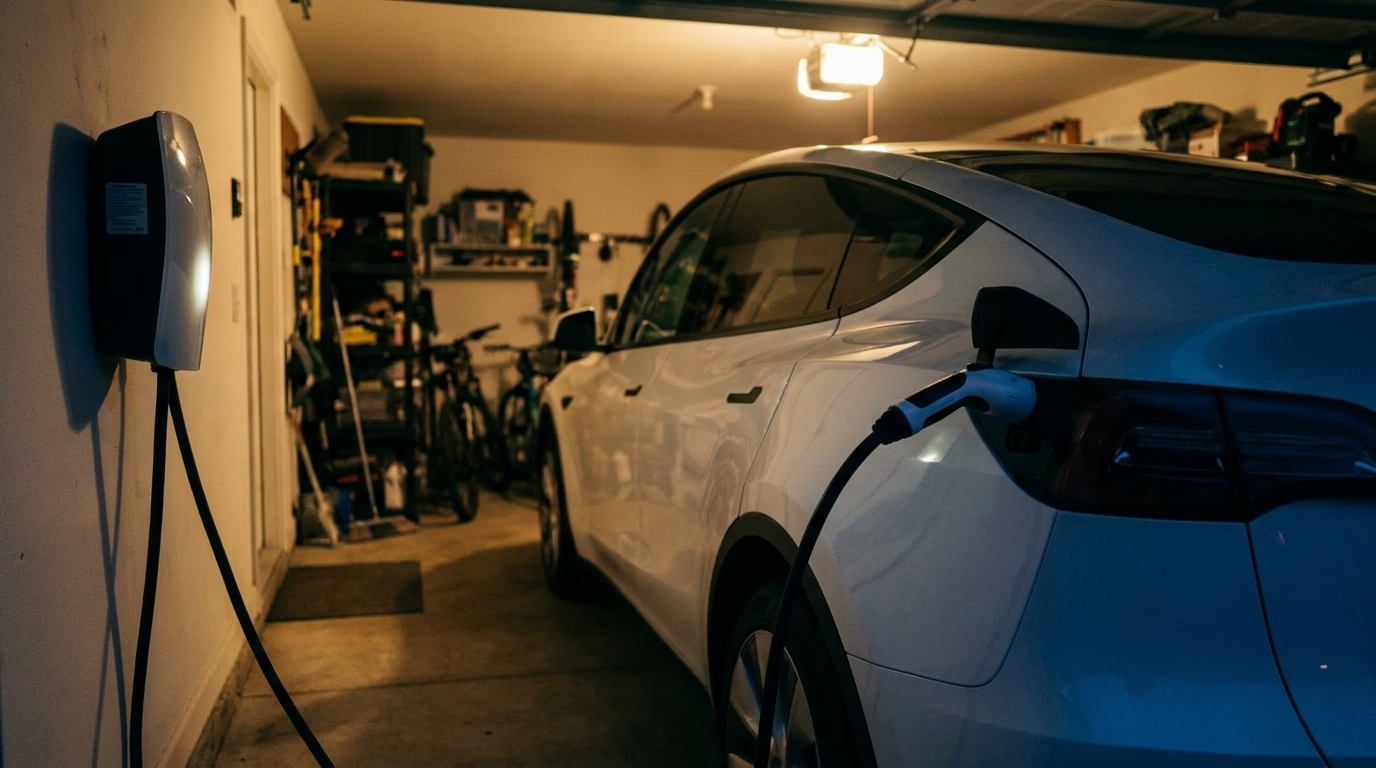
Making the switch to an electric vehicle is one of the most significant automotive decisions you’ll face as a modern driver. The conversation around EVs has become loud, polarized, and often unhelpful — on one side, enthusiasts who treat electrification as a moral imperative, and on the other, skeptics who dismiss the technology as impractical hype. Neither camp is doing you any favors when you’re standing in a dealership trying to make a smart financial and lifestyle decision. This guide cuts through both extremes to give you a clear-eyed, practical look at what EV ownership actually involves — the real costs, the genuine conveniences, and the honest limitations you need to weigh before signing anything.
Upfront Cost vs. Lifetime Savings Breakdown
The sticker shock of an EV is real. The average transaction price for a new electric vehicle in the United States was approximately $55,000 in early 2024, compared to roughly $48,000 for the average new gasoline vehicle. However, that headline comparison is misleading without context.
The federal government’s Clean Vehicle Credit offers up to $7,500 off qualifying new EVs purchased through 2032, subject to income limits and vehicle MSRP caps. Many states layer additional incentives on top — Colorado offers up to $5,000, and California provides up to $7,500 through the Clean Vehicle Rebate Project for eligible buyers. That can meaningfully close the gap.
Where EV ownership genuinely shines is in operating costs. Electricity is cheaper per mile than gasoline almost everywhere in the country. The average American pays roughly $0.16 per kilowatt-hour (kWh) for residential electricity. A typical EV consumes about 3 to 4 miles per kWh, putting your fuel cost at approximately 4 to 5 cents per mile. A gasoline car averaging 30 MPG at $3.50 per gallon costs about 12 cents per mile. Over 15,000 miles annually, that’s roughly $600 per year in electricity versus $1,800 in gasoline — a $1,200 annual difference that compounds meaningfully over a five-to-seven-year ownership period.
Monthly Cost Comparison Worksheet
| Category | Gas Vehicle (Estimate) | Electric Vehicle (Estimate) |
|---|---|---|
| Monthly fuel cost (1,250 mi) | $145 | $48 |
| Monthly maintenance (avg.) | $100 | $50 |
| Monthly insurance | $150 | $165 |
| Monthly total | $395 | $263 |
| Annual savings with EV | — | ~$1,584 |
Insurance costs for EVs run slightly higher on average due to higher repair costs for some models, so factor that in honestly. Your specific savings will depend on local electricity rates, your driving volume, and the specific vehicles being compared.
Home Charging Setup and What It Actually Costs
This is the section most EV marketing glosses over, and it deserves your full attention. The charging experience at home is EV ownership’s biggest practical advantage — but only if your home is ready for it.
Every EV comes with a Level 1 charger that plugs into a standard 120-volt household outlet. It’s functional but slow, adding roughly 3 to 5 miles of range per hour. If you drive fewer than 30 miles daily, Level 1 charging can work — you plug in overnight and wake up with a full battery. For most drivers, however, a Level 2 charger running on 240 volts is the practical standard. It adds 20 to 30 miles per hour of charging, meaning a full charge from near-empty overnight.
Home Electrical Panel Readiness Checklist
Before purchasing a Level 2 charging unit, work through this checklist with an electrician:
- [ ] Does your panel have at least 200-amp service? (100-amp panels may require costly upgrades)
- [ ] Is there available capacity for a dedicated 40- or 50-amp circuit?
- [ ] Is your panel located where running a circuit to your garage or driveway is practical?
- [ ] Are you in a home you own, or renting? (Renters face added complexity)
- [ ] Does your utility offer a time-of-use rate plan that rewards overnight charging?
- [ ] Is your home in a jurisdiction that requires permits for EVSE installation?
The Level 2 charging unit itself costs between $400 and $900 for a quality residential unit from brands like ChargePoint, Grizzl-E, or Wallbox. Installation by a licensed electrician typically runs $200 to $1,000 depending on panel distance and any necessary electrical upgrades. Budget $500 to $2,000 all-in for a realistic installation estimate. If your panel needs upgrading, add $1,500 to $4,000 to that figure.
If you live in an apartment or condo without dedicated parking, home charging may not be feasible at all — and your EV experience will depend entirely on public charging infrastructure, which is a very different ownership model.
Understanding Range Anxiety and How to Manage It
Range anxiety — the fear of running out of battery before reaching a charger — is the most-discussed psychological barrier to EV adoption. Here’s the honest assessment: it’s partly overblown and partly legitimate, depending entirely on how you drive.
The average American drives approximately 37 miles per day. Most modern EVs offer at least 250 miles of EPA-rated range, with many exceeding 300 miles. For daily commuting and local errands, range is rarely a genuine issue for drivers with home charging. You start every morning with a full “tank.”
That said, real-world range does diverge from EPA estimates. Cold weather can reduce range by 20 to 40 percent. Highway driving at 75 mph or above is significantly less efficient than the mixed-cycle testing used to determine EPA range. Running the heat at full blast in winter further compounds the reduction. These are real limitations, not manufacturer propaganda.
Practical strategies to manage range anxiety:
- Adopt the 80/20 rule. Most manufacturers recommend keeping the battery between 20 and 80 percent for daily use to preserve long-term health. Know your real-world usable range within those limits.
- Plan charging stops proactively. Apps like PlugShare, A Better Routeplanner (ABRP), and your vehicle’s native navigation system allow you to plan charging stops before they become emergencies.
- Think in percentage, not miles. Drivers who recalibrate their mental model from “how far can I go?” to “how much charge do I have for today’s plan?” find anxiety diminishes quickly with experience.
Maintenance Differences Compared to Gas-Powered Cars
This is one of the clearest, most concrete advantages of EV ownership. Electric drivetrains have dramatically fewer moving parts than internal combustion engines, and the maintenance schedule reflects that.
Gone are oil changes, transmission fluid services, spark plugs, timing belts, exhaust system repairs, and fuel system maintenance. The Consumer Reports 2023 reliability survey found that EV owners spend, on average, roughly 40 percent less on maintenance and repairs than gas vehicle owners over the same period.
What EVs do still require: tire rotations (more frequently, because EVs are heavier and have strong instant torque), brake inspections (though regenerative braking significantly extends brake life), cabin air filter replacements, windshield washer fluid, and battery coolant checks in some models. The 12-volt auxiliary battery — a component many new EV owners don’t know exists — also requires monitoring and eventual replacement.
Battery degradation is a legitimate long-term consideration. Most manufacturers warranty the battery pack for 8 years or 100,000 miles, guaranteeing a minimum state of health (typically 70 percent capacity). Real-world data from Recurrent, which tracks thousands of EVs, suggests many popular EV batteries retain around 90 percent capacity after 100,000 miles — better than early skeptics predicted, but not indefinitely flat.
Road Trips and the Public Charging Network Reality
Road tripping in an EV is genuinely different from road tripping in a gas car — not impossible, but it requires planning that gasoline drivers simply don’t think about. Being honest about this prevents post-purchase regret.
Tesla’s Supercharger network remains the gold standard for reliability and coverage, with over 20,000 connectors in North America. Following Tesla’s opening of the network to other vehicles, non-Tesla EV drivers now have access to many Supercharger locations, which meaningfully improves the landscape. The broader public charging network, including providers like Electrify America, EVgo, and ChargePoint, has expanded significantly — but reliability remains a documented issue. A 2023 study from J.D. Power found that EV drivers encounter a non-working charger approximately 21 percent of the time at public DC fast charging stations.
DC fast charging (Level 3) is the road trip solution — it adds 100 to 200 miles of range in 20 to 40 minutes depending on the vehicle. Most modern EVs from major manufacturers now support speeds of 150 kW or above. For reference, a 20-minute charging stop every 2 to 3 hours of highway driving roughly mirrors the cadence of a gas stop plus bathroom break when you account for the time most drivers would spend anyway. Whether that trade-off feels acceptable is deeply personal.
For drivers who take long road trips monthly or more, and who travel routes underserved by fast chargers, this is a genuine consideration that honest EV proponents should not minimize.
Is an EV Right for Your Lifestyle?
Decision Matrix: Urban vs. Rural Drivers
| Factor | Urban Driver | Rural/Suburban Driver |
|---|---|---|
| Daily mileage | Typically lower | Often higher |
| Home charging access | Often difficult (apartments) | Usually easier (garage/driveway) |
| Public charging access | Generally good | Often limited |
| Road trip frequency | Lower | Often higher |
| Fuel cost savings | High | High, but offset by charging costs |
| EV suitability | Moderate to high (if home charging possible) | Moderate (depends on range and trips) |
| Recommended action | Verify home charging before buying | Prioritize high-range models; map your routes |
An EV is likely a strong fit if: you own your home or have confirmed charging access, you drive predictably and mostly locally, you have access to a gasoline vehicle or rental for occasional long trips, and your local electricity rates are reasonable.
An EV may not be the right fit yet if: you live in an apartment without dedicated charging, you regularly drive more than 300 miles in a single day without flexibility, you live in an extremely cold climate and have significant range concerns, or your local fast-charging infrastructure is sparse and unreliable.
The right answer is neither “everyone should own an EV” nor “EVs aren’t ready.” They are ready — for a specific set of use cases and living situations that happen to describe a large share of the American driving population. Your job is to evaluate honestly whether your life is among them.
Take the time to test drive the specific model you’re considering, run your own numbers using local electricity rates and your actual commute, talk to an electrician before committing, and route-plan a road trip you actually take. That ground-level research will tell you more than any review — including this one.
Sources and Further Reading
- Federal Clean Vehicle Tax Credit (IRS): https://www.irs.gov/credits-deductions/credits-for-new-clean-vehicles-purchased-in-2023-or-after
- Colorado EV Tax Credit (CDOR): https://tax.colorado.gov/innovative-motor-vehicle-credit
- California Clean Vehicle Rebate Project (CARB): https://cleanvehiclerebate.org
- Average U.S. residential electricity rates (EIA): https://www.eia.gov/electricity/monthly/
- Average U.S. gas prices (AAA): https://gasprices.aaa.com
- EV battery degradation data (Recurrent): https://www.recurrentauto.com/research
- J.D. Power 2023 EV Experience Report: https://www.jdpower.com/business/press-releases/2023-us-electric-vehicle-experience-public-charging-study
- Consumer Reports EV maintenance data: https://www.consumerreports.org/cars/hybrids-evs/
- PlugShare (public charger map): https://www.plugshare.com
- A Better Routeplanner (ABRP): https://abetterrouteplanner.com
