
Best Sports to Play for Lifelong Fitness
Why the Sport You Choose Now Could Add Years to Your Life
Most people think of exercise in terms of gym memberships, treadmill sessions, or weekly runs. But a growing body of research suggests that the type of activity you choose — not just the amount — plays a significant role in how long and how well you live. Sports, in particular, offer something that solitary exercise often cannot: social connection, structured play, and a competitive or cooperative framework that keeps people coming back decade after decade.
If you are looking to invest in an activity that will serve your body and your social life well into your 70s, 80s, and beyond, the science points clearly toward a handful of sports that deliver outsized returns on longevity.
What the Research Actually Says
The most frequently cited study in this area is the Copenhagen City Heart Study, a large-scale Danish cohort study that tracked more than 8,500 participants over 25 years. Researchers analyzed the life expectancy gains associated with different types of physical activity and published landmark findings in the Mayo Clinic Proceedings in 2018.
The results were striking. Tennis players lived an average of 9.7 years longer than sedentary individuals — the highest gain of any sport studied. Badminton came in second at 6.2 years, followed by soccer (4.7 years), cycling (3.7 years), swimming (3.4 years), jogging (3.2 years), and calisthenics (3.1 years).
What separated the top performers from jogging or gym work? The researchers pointed to social interaction as a key variable. Sports played with others — especially those requiring partners or teammates — appeared to amplify cardiovascular and psychological benefits in ways that solo exercise simply does not replicate.
A separate 2016 study published in the British Journal of Sports Medicine, drawing on data from over 80,000 adults in England and Scotland, similarly found that racquet sports were associated with a 47% lower risk of all-cause mortality compared to no activity, and a 56% lower risk of cardiovascular disease mortality.
Tennis: The Gold Standard for Longevity
Between the Copenhagen findings and the British cohort data, tennis has emerged as the single most well-researched sport for longevity. It combines aerobic conditioning, lateral movement, hand-eye coordination, and social engagement into a package that is both competitive and adaptable.
Tennis scales remarkably well with age. Beginners can start at any point in adulthood, and the sport’s scoring system naturally accommodates slower play without eliminating the fun. Doubles tennis, in particular, reduces court coverage requirements while preserving the social and tactical elements that make the game engaging.
Masters leagues — age-bracket competitive leagues for players 30 and older — are widely available through the United States Tennis Association (USTA), which offers leagues segmented into divisions up to 85 and over. Club memberships vary considerably: public court access through municipal parks is often free or low-cost (typically $5–$15 per hour for court reservations), while private tennis clubs range from approximately $1,200 to $5,000+ per year depending on location and amenities.
Swimming: The Lifelong Equalizer
Swimming is one of the few sports that genuinely accommodates nearly every age and physical condition. The buoyancy of water offloads stress from joints, making it ideal for individuals managing arthritis, hip or knee problems, or recovering from injury.
Research supports its longevity benefits strongly. A long-running study from the University of South Carolina tracking more than 40,000 men over 32 years found that swimmers had a 50% lower death rate than runners, walkers, or sedentary individuals across all age groups.
Swimming engages the full body, improves cardiovascular efficiency, maintains muscle mass, and has been shown to support balance and coordination — all critical factors in healthy aging. Masters swimming programs, organized through U.S. Masters Swimming (USMS), host competitions in age groups starting at 25 and running through 100+. Annual USMS membership costs approximately $45–$60, with most pool lap lanes available for modest monthly fees at local YMCAs or recreation centers, typically ranging from $30 to $70 per month.
Cycling: Accessible, Scalable, and Proven
Cycling’s longevity credentials are well documented. The Copenhagen City Heart Study credited cyclists with 3.7 additional life-years, and a landmark study of Tour de France cyclists published in the International Journal of Sports Medicine found that professional cyclists lived an average of 6.3 years longer than the general population — a finding that speaks to the long-term cardiovascular adaptations the sport promotes.
Cycling is also exceptionally low-impact on joints, which makes it sustainable well into later decades. Stationary cycling (indoor spin classes or home bikes) offers a weather-independent alternative, and e-bikes have dramatically expanded access for older riders who want to continue group rides without the pressure of keeping pace on hills.
Road cycling clubs are among the most socially active sporting communities, with group rides typically organized by ability level. Entry costs vary: a quality road bike ranges from $800 to $3,000+, though many people begin with used bikes or community rental programs. Club memberships are often low-cost, frequently $30–$100 annually through organizations like USA Cycling.
Pickleball: The Fastest-Growing Sport for a Reason
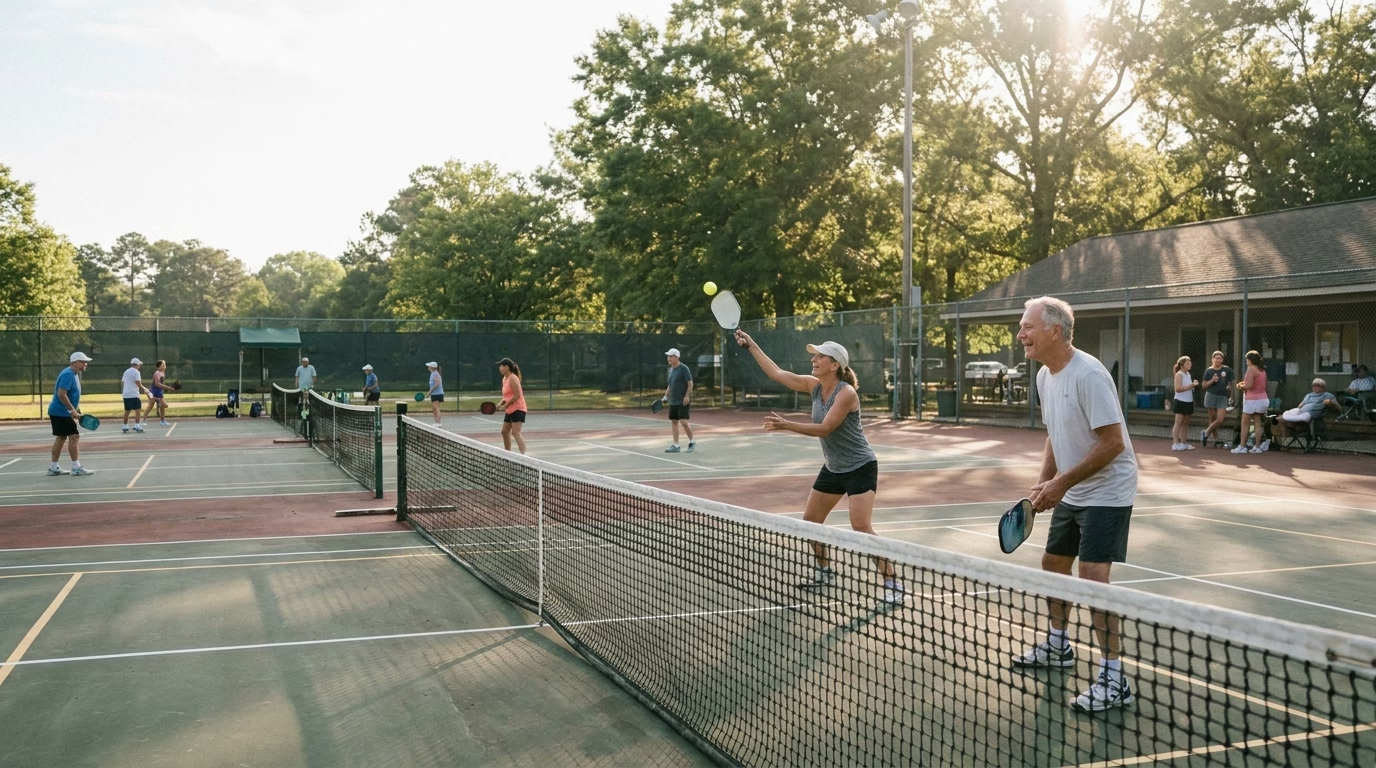
Pickleball has exploded in popularity, and for good reason — it is arguably the most accessible racquet sport for older beginners. Played on a smaller court than tennis with a lower net and a perforated plastic ball, it is significantly easier on joints while preserving the social, competitive, and reactive elements that make racquet sports so beneficial.
While long-term longitudinal studies on pickleball specifically are still emerging (the sport’s mainstream popularity is relatively recent), early research from Brigham Young University found that recreational pickleball players met vigorous exercise intensity thresholds and reported elevated mood and well-being compared to baseline. Given its structural similarities to badminton — which scored 6.2 additional life-years in the Copenhagen study — its potential longevity benefits are encouraging.
Pickleball is a genuinely low-cost sport to enter. Paddles range from $30 to $150, and courts are increasingly available for free at community recreation centers, parks, and YMCAs. Organized leagues and drop-in sessions are free or nominally priced in most communities, and the USA Pickleball Association maintains a national directory of courts and clubs.
Golf (With Walking): More Than a Leisure Activity
Golf has long been dismissed as “not really exercise,” but that perception deserves revision — particularly when the cart is left behind. A series of studies conducted by researchers at the Karolinska Institute in Sweden found that golfers have a 40% lower death rate than non-golfers of the same age, gender, and socioeconomic background, translating to an estimated 5 years of additional life expectancy.
Walking an 18-hole course covers approximately 5 to 7 miles and burns 1,000–1,500 calories, depending on terrain and carrying a bag versus using a pull cart. The cognitive demands of the game — course management, club selection, reading terrain — also provide meaningful mental engagement that supports brain health with aging.
Golf’s social structure — regular foursomes, club leagues, and casual rounds — mirrors the relationship-based benefits identified in the Copenhagen study. The cost is its primary barrier: green fees range widely from $20 at public municipal courses to well over $100 at private clubs, and private club memberships can run $5,000 to $30,000+ annually. However, public and semi-private courses make the sport broadly accessible, particularly for those willing to play off-peak hours.
The Social Factor: Why It Matters More Than You Think
Across every sport covered in this article, one variable repeatedly surfaces in the longevity data: social connection. The Copenhagen researchers explicitly noted that the life-expectancy advantage of racquet sports over solo activities like jogging appeared to be partly explained by their social dimension.
This aligns with broader research on aging. A landmark 80-year Harvard Study of Adult Development identified the quality of relationships — not cholesterol levels, fitness, or wealth — as the single strongest predictor of late-life health and happiness. Sports that require partners, teammates, or regular club participation build exactly those kinds of ongoing social bonds.
Doubles tennis, pickleball, group swim sessions, cycling clubs, and golf foursomes all provide regular, structured social contact that reinforces commitment, adds accountability, and delivers psychological benefits beyond the purely physical.
Choosing the Right Sport for Your Stage of Life
No single sport is right for everyone. Joint health, prior injury history, budget, and geography all shape what is practical. A useful framework is to prioritize low-impact options if you are managing joint issues (swimming, cycling, pickleball), socially structured sports if motivation is your primary challenge (tennis leagues, golf clubs, masters swimming), and scalable activities if you plan to play for decades regardless of how your fitness evolves.
The encouraging truth is that the best sport for longevity is largely the one you will actually do consistently. The research strongly favors racquet sports and swimming, but it also consistently shows that any sustained, socially engaged physical activity outperforms sedentary behavior by a wide margin.
Start somewhere. Find a club, a partner, or a league. The data suggests your future self will thank you.
This article is intended for general informational purposes only and does not constitute medical advice. Always consult a qualified healthcare provider before beginning a new exercise program, particularly if you have existing health conditions.
Sources & Further Reading
- Schnohr, P. et al. (2018). Various Leisure Time Physical Activities Associated with Widely Divergent Life Expectancies. Mayo Clinic Proceedings. https://www.mayoclinicproceedings.org/article/S0025-6196(18)30538-X/fulltext
- Wen, C.P. et al. (2016). Specific Sports and Cause-Specific Mortality. British Journal of Sports Medicine. https://bjsm.bmj.com/content/50/15/950
- Blair, S.N. et al. Swimming and All-Cause Mortality. University of South Carolina / International Journal of Aquatic Research and Education.
- Farahmand, B. et al. Golf: A Game of Life and Death. Karolinska Institute / Scandinavian Journal of Medicine & Science in Sports. https://pubmed.ncbi.nlm.nih.gov/19341565/
- Waldinger, R. The Harvard Study of Adult Development. https://www.adultdevelopmentstudy.org/
- USTA League Tennis: https://www.usta.com/en/home/play/adult-tennis/programs/national/usta-league.html
- U.S. Masters Swimming (USMS) membership and pricing: https://www.usms.org/join-usms
- USA Pickleball court finder and membership: https://www.usapickleball.org/
- USA Cycling membership: https://www.usacycling.org/
