
The Best Houseplants for Air Quality
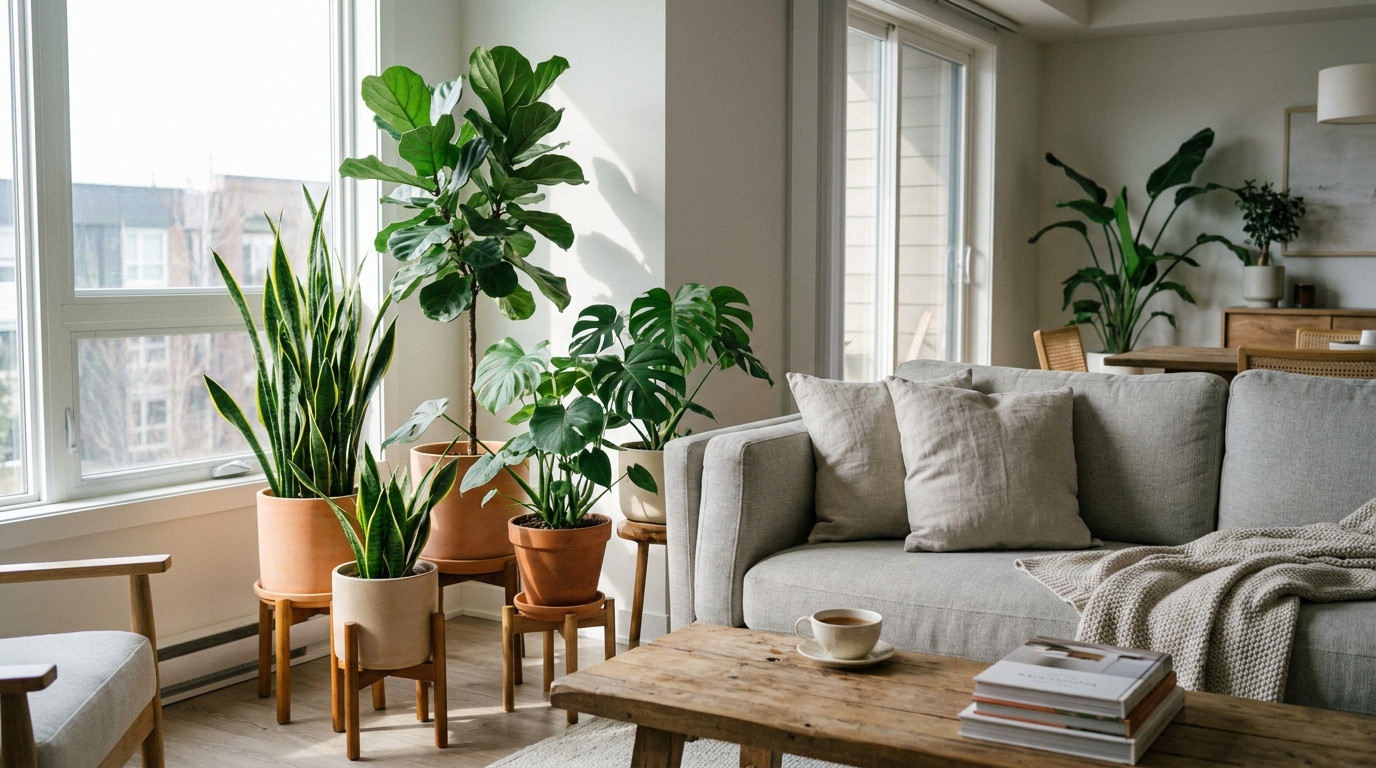
The Truth About Houseplants and Air Quality: What Science Actually Says
Walk into any garden center or scroll through a home décor account online, and you’ll encounter the same irresistible promise: fill your home with plants, breathe cleaner air. It’s a message that sells millions of pothos cuttings and snake plants every year, and it’s rooted in a kernel of real science. But like many things filtered through decades of marketing and social media, the full picture is considerably more nuanced. Before you spend a Saturday afternoon rearranging your living room into a botanical garden, it’s worth understanding what the research actually shows — and what actually moves the needle on the air inside your home.
The Study That Started It All: NASA’s Clean Air Research
In 1989, NASA scientist B.C. Wolverton and his colleagues published what would become one of the most cited — and most misrepresented — studies in environmental science. Conducted in partnership with the Associated Landscape Contractors of America, the research set out to solve a very specific problem: how do you purify the air inside a sealed space station, where volatile organic compounds (VOCs) like benzene, trichloroethylene, and formaldehyde can accumulate with nowhere to go?
The answer, according to Wolverton’s team, involved plants. In a series of controlled experiments conducted in sealed, roughly 0.07 cubic meter (2.5 cubic foot) chambers — about the size of a small plastic tub — researchers introduced specific pollutants and measured how effectively different plant species could remove them over 24-hour periods. The results were genuinely impressive. Several species reduced concentrations of VOCs significantly, with removal rates sometimes exceeding 80% for certain chemicals.
Wolverton’s subsequent book, How to Grow Fresh Air (1996), popularized the idea that houseplants could meaningfully purify indoor air, and the concept took on a life of its own in the decades that followed. By the 2010s, the “NASA plant study” had become a staple reference in wellness content, with the recommendation that 15–18 plants per 1,800 square feet could meaningfully purify a home’s air being repeated across thousands of articles and blog posts.
The science sounded solid. The premise was appealing. There was just one significant problem: the conditions of the experiment had almost nothing to do with a real home.
What Later Research Actually Found
In 2019, a team of researchers led by Michael Waring at Drexel University published a comprehensive analysis in the Journal of Exposure Science & Environmental Epidemiology that reexamined the NASA findings and subsequent plant-air-purification studies with a critical eye. Their conclusion was blunt: houseplants have a negligible effect on indoor air quality in real-world conditions.
The core issue is a concept called the clean air delivery rate (CADR), which measures how quickly a purification system removes pollutants from a realistically sized space. In the NASA experiments, the sealed chambers were so small that even modest biological activity from the plants could reduce VOC concentrations meaningfully. But when Waring’s team scaled those removal rates up to a typical room — say, a 15 by 15 foot bedroom — the math fell apart.
A real home is not a sealed chamber. It has air exchange driven by ventilation systems, gaps in windows and doors, the movement of people, and dozens of variables that constantly dilute indoor pollutants. In these conditions, the rate at which houseplants remove VOCs is orders of magnitude slower than natural air exchange. The study found that you would need somewhere between 100 and 1,000 plants per square meter of floor space to compete with the VOC reduction that a building’s normal ventilation already provides passively.
That is not a typo. Not 10 plants per room. Not even 50. In conditions that would make clinical air quality improvements detectable, you would essentially need to live inside a jungle — a scenario that creates its own set of problems, including humidity buildup, mold risk, and soil-borne bacteria.
The Top-Tested Species: What They Can and Can’t Do
None of this means the plants themselves are fraudulent. The species most frequently cited in air-quality literature are real, beautiful plants with genuine horticultural merit. Here’s what the research shows they can — and cannot — do.
Snake Plant (Sansevieria trifasciata): One of the most studied species, the snake plant was shown to absorb benzene, formaldehyde, trichloroethylene, xylene, and toluene in chamber studies. It also performs a mild form of CAM photosynthesis, meaning it releases a small amount of oxygen at night. Extremely low-maintenance and drought-tolerant.
Peace Lily (Spathiphyllum spp.): Consistently among the top performers in VOC removal studies, particularly for acetone, alcohols, and benzene. It also showed some capacity to reduce airborne mold spores by absorbing them through its leaves and roots. Note: mildly toxic to pets.
English Ivy (Hedera helix): Wolverton’s research ranked this as one of the most effective VOC removers. Some studies also suggest it may reduce airborne fecal particles and mold. However, English ivy is invasive outdoors and toxic if ingested by children or pets.
Spider Plant (Chlorophytum comosum): A forgiving, fast-growing plant that showed notable effectiveness against carbon monoxide and formaldehyde in chamber tests. One of the safest options for households with pets.
Rubber Plant (Ficus elastica): Showed effectiveness at absorbing formaldehyde specifically, likely due to the large surface area of its broad, waxy leaves. Prefers bright indirect light and moderate watering.
Boston Fern (Nephrolepis exaltata): Wolverton rated this as one of the top air purifiers overall, particularly for removing formaldehyde and xylene. It also acts as a natural humidifier, releasing moisture through transpiration — useful in dry climates, though it requires consistent humidity itself to thrive.
Pothos (Epipremnum aureum): Perhaps the most popular houseplant in the world, pothos is nearly indestructible and showed meaningful VOC removal in studies, particularly for benzene and formaldehyde. Its trailing growth habit maximizes leaf surface area relative to pot size.
Dracaena (Dracaena spp.): Multiple species in this genus appeared in the original NASA study, showing effectiveness against trichloroethylene, benzene, and formaldehyde. Available in many varieties, though toxic to cats and dogs.
The pattern across all these plants is consistent: in controlled, small-scale chamber environments, they remove measurable quantities of VOCs. In your living room, the effect is real but small — far too small to register as a meaningful change in air quality under normal conditions.
How Many Plants Would You Actually Need?
Let’s be specific. Waring’s 2019 analysis found that the average VOC removal rate of a potted plant is approximately 0.023 m³ of air per hour. A standard HEPA air purifier, by contrast, can process between 200 and 400 m³ per hour, depending on the model.
To match even a modest HEPA purifier, you would need thousands of plants. To reach the threshold of clinically meaningful air quality improvement — a level at which health outcomes could realistically improve — researchers suggest the number climbs into the hundreds per standard-sized room. Even the most optimistic interpretations of the plant research suggest that 30 or more plants per 100 square feet would be necessary to make a dent, and that’s before accounting for normal ventilation diluting the effect.
In practical terms, achieving meaningful air purification through plants alone is not feasible in a residential setting. The math simply doesn’t support it.
What Actually Works
If houseplants can’t move the needle on air quality in a realistic home environment, what does? The good news is that effective options exist, and several of them are free or low-cost.
HEPA Air Purifiers: These are the most thoroughly evidence-backed tools for reducing indoor particulate matter, including PM2.5 (fine particles linked to cardiovascular and respiratory disease), dust, pet dander, pollen, and some pathogens. Quality units from established brands like Coway, Winix, or Blueair range from roughly $80 to $400 depending on room coverage. Look for a CADR rating appropriate to your room size.
Ventilation: Simply opening windows when outdoor air quality is good is one of the most effective free interventions for diluting indoor VOCs and carbon dioxide. The EPA consistently identifies inadequate ventilation as the primary driver of poor indoor air quality in homes.
Source Removal: This is arguably the most impactful strategy of all, and it costs nothing. VOCs in homes come primarily from off-gassing materials — new furniture, paints, cleaning products, synthetic carpets, air fresheners, and scented candles. Choosing low-VOC paints, allowing new furniture to off-gas in a garage before bringing it inside, switching to fragrance-free cleaning products, and avoiding synthetic air fresheners can dramatically reduce pollutant loads without any purification technology at all.
Regular Cleaning: Vacuuming with a HEPA-filter vacuum, damp-mopping floors, and washing bedding frequently reduces particulate matter — dust mites, pet dander, and tracked-in pollutants — more effectively than any number of plants on a windowsill.
A Balanced Recommendation
Here is what the science actually supports: houseplants are not air purifiers in any meaningful clinical sense when kept in realistic numbers in a real home. The original NASA research, while genuine, was conducted in conditions so far removed from normal living spaces that its conclusions don’t transfer. Subsequent research has confirmed this repeatedly.
But that doesn’t mean you should get rid of your pothos or feel deceived for loving your snake plant. Plants offer real, documented benefits that have nothing to do with HEPA filtration. They reduce psychological stress, improve mood, increase productivity, and make spaces feel more alive and habitable — effects supported by consistent research in environmental psychology. They add humidity to dry indoor environments, which can benefit respiratory comfort. And if they motivate someone to spend more time at home and less time in traffic, the net health effect is arguably positive.
Buy plants because you love them, because they make your home more beautiful, and because caring for living things is good for the human psyche. Just don’t rely on them to protect your lungs. For that, open a window, invest in a HEPA purifier, and check what’s off-gassing from your furniture.
Sources and Further Reading
- Wolverton, B.C., Johnson, A., & Bounds, K. (1989). Interior Landscape Plants for Indoor Air Pollution Abatement. NASA Technical Report. https://ntrs.nasa.gov/citations/19930073077
- Waring, M.S., Siegel, J.A., & Corsi, R.L. (2019). Potted plants do not improve indoor air quality: a review and analysis of reported VOC removal efficiencies. Journal of Exposure Science & Environmental Epidemiology. https://www.nature.com/articles/s41370-019-0175-9
- U.S. Environmental Protection Agency — Indoor Air Quality: https://www.epa.gov/indoor-air-quality-iaq
- Coway AP-1512HH HEPA Air Purifier (~$100–$130): https://www.amazon.com/dp/B01728NLRG
- Blueair Blue Pure 211+ (~$250–$300): https://www.blueair.com/us/air-purifiers/blue-pure-211-plus
- Wolverton, B.C. (1996). How to Grow Fresh Air. Penguin Books.
